Wednesday, October 10, 2012

Museum of Naval Aviation, Part 1


 On my recent 1738 mile road trip, I made a special point to swing by Pensacola, Florida so that I could see the Museum of Naval Aviation, located on the Pensacola Naval Air Station. It did not disappoint. This is quite simply one of the greatest aviation museums in
the entire world. Even though I am going to split this into a couple of parts, I will only be showing a small part of their collection. I highly recommend you visit.  (and it is FREE!)


A rare find- the Vought Vindicator SBU2. In fact, the only only one in existence. This aircraft crashed into Lake Michigan in 1943 while operating off the training aircraft carrier Wolverine (IX 64). It was recovered in 1990. The SBU2 was intended as a scout/bomber aircraft, functioning as the eyes, ears and sword of the Navy, hunting down enemy surface warships. It was fairly well set for that mission when it was first produced, boastinga maximum speed of 251 mph (404km/h) and a range of 630 miles( 1,014km). But due to the vast and fast technological advances of the era, the Vindicator was technically obsolete at the start of WWII. It was too lightly armed with a single forward firing machine gun and a flexible mount for the tailgunner's machine gun for defense. It could carry up to 1,500lbs (680kg) of bombs, including a 1000 pounder (450kg)  mounted on a swinging trapeze below the fuselage so that it wouldn't hit the propeller when in a steep dive. It also was partially fabric covered with aluminum plates covering the fuselage forward of the cockpit. The Vindicator served aboard four US Navy carriers until 1942 and in the USMC until 1943. It then served as a training aircraft in both the US Navy and the Royal Navy for the duration of the war. 


This one might not look particularly impressive, but it is an AIM-26A. It was the first air-to-air guided missile with a nuclear warhead. It was a variant of the Falcon missile series and designed with the idea of firing it at long range into a approaching formation of supersonic bombers. It mounted a sub kiloton W54 warhead, which was rated at 250 tons of TNT. The W54 warhead shared its design with the Mk-54 projectile developed for the "Davy Crockett" nuclear recoilless rifle. The W54 warhead weighed about 50lbs (23kg) The missile was guided by radar to give it longer range and all-weather capability. It had a range of about 6 miles (9.7km) . The Nuclear Falcon was brought into service in 1960 and retired in 1972. Its nuclear warheads were then rebuilt for the AGM-62 "Walleye" glide bomb. How's that for Federal Government efficiency?


Here we have the F7U "Cutlass". As you can see, this aircraft does not have a conventional tail and instead uses what is known as semi-tailless design. It used surfaces now called elevons to control pitch and roll. The basic idea for this was amongst data captured from the German aeronautical firm Arado as the end of WWII. The aircraft was designed by Rex Beisel, who also designed the first aircraft specifically made for the US Navy. While a really neat and advanced design, the Cutlass was plagued with engines that did not have enough power and had a tendency to flame out.  Unfortunately, 4 test pilots and 21 other Naval Aviators were killed in F7U crashes. Ultimately, more than 25% of the production run of the F7U were destroyed in crashes. As such, the aircraft was not well liked by pilots and began to acquire some rather unflattering nicknames. The first was the "Gutless Cutlass:, a play on the performance of the underpowered Westinghouse J46-WE-8B engines. The second, more grim name was the "Ensign Eliminator", so named because of its difficult flying characteristics, especially for junior pilots.


 Here we have a A-4 Skyhawk, A lightweight ground attack aircraft that saw service with the Navy during the Vietnam War. It was used in bombing raids over North Vietnam and as close air support aircraft for troops in contact. Ultimately, 362 Skyhawks were lost to all causes during Vietnam. A nimble aircraft, it was used for many years in Dissimilar Air Combat Training, standing in for the MiG-17. It served in that role until 2003.


The amazing F-14 Tomcat. This is the aircraft that made the last combat flight of the US Navy Tomcats. The flight was made supporting Operation Iraqi Freedom on February 8, 2006.

Wednesday, September 26, 2012

Peace Through Superior Firepower


A phrase I like so much that I have it on a T-shirt


See? And with my favorite fictional gun, too

Tennessee Punt Gun


 Here is another interesting tidbit from my recent road trip.  The weapon at the top of the case is called a punt gun. And those rifles below it are full sized Kentucky and Tennessee rifles. Not exactly small guns themselves.


A punt gun is a huge fowling piece intended to be used while propped on the prow of a small boat or "punt". It was a smoothbore weapon of truly massive caliber that was used to shoot a large number of ducks or geese with one shot. Documents state that between ten and forty birds could be killed with a single shot. Which is good, because it probably took two guys with a ladder ten minutes to load it. This weapon was a matchlock as you can see in the above photo, and probably from the early to mid 1700's.


These photos were taken in the Pink Palace Museum in Memphis, Tennessee

Audie Murphy's uniform


These pictures were taken in the Willy Nelson Museum in Nashville, TN. (of all places)

The tag near the uniform states that the uniform and helmet were given to a friend of Lt. Murphy's by the name of Scott Turner. The displayed medals, 1911A1, Luger P08 and the dagger just out of the frame were found in the back room of a California ranch that Audie Murphy sold to Bob Hope in 1966.

For those that don't know, Audie Murphy was the most decorated US soldier in WWII and went on to star in many Hollywood movies, including one based on his own life and experiences in the war.

Cool stuff, and certainly something I did not expect to see.

Monday, September 24, 2012

Georgia tanks


M60 Main Battle Tank


Here we see what happens when I am stuck out of town for work and bored. I went out looking for some Taco Bell and paint brushes and found a M48 Patton tank. Awesome, right? So I decided to try my little phone camera and its effects. My phone, by the way is a Casio Gz'one Ravine. It is not smart, it does not have a touch screen. But amongst other things, it is close to completely waterproof. I was talking on it while in the shower this morning.

Do that with your precious iPhones, hipsters.

With this one I was trying to make it look like an old newsreel footage, so naturally I used the black and white filter. I think it certainly does not look like it was taken in Augusta, GA in 2012
  

How about a couple of fake nightvision shots?

Anything to avoid getting work done, I tried to make this one look like a thermal scope on white=hot.           For some reason this M48 was painted black instead of OD green or camo and I think that helped the effect. 

Both of these tanks are "gate guards" at American Legion posts in Georgia, hence the title.

Saturday, August 18, 2012

Dinosaur Hunting

Since I can't think of anything serious that I want to post about today, we will instead delve into that most important of gun questions. No, not 9mm NATO versus .45 ACP, not even 5.56mm versus 7.62mm. Today we discuss which firearms we would use on dinosaurs. Of course Dinosaurs came in all shapes and sizes. (BTW, I got a science credit for taking a 2000 level Geology course about dinosaurs. Best class in four years of university, hands down. Made an A, too.)  So for the purpose of this admittedly silly exercise, we will be thinking about the most famous and Jurassic Park-y dinos. Oh look, here is a nifty size comparison chart.


It all started back in 1997 with the N64 release of Turok: Dinosaur Hunter.  For those of you who don't know Turok was a comic book character dating back to 1954. So fast forward and he makes a great video game protagonist, because he gets to shoot dinosaurs. In the video games he also fights intelligent, sci-fi dinosaurs with neato space guns as well.


First up on the list, a gun that isn't even in production. It is the Barrett Payload Rifle also known as the XM109, an attempt to further the design of their famous M107 .50 caliber rifle. It was designed to fire a 25x59mm explosive shell, making it a rifle that is more powerful than than the "Light .50". Hence the "payload" which would be High Explosives. The same round was developed for use in the XM307 Advanced Crew Served Weapon. It also was listed as having an effective range of 2000 meters. Which, coincidentally, is about as close as I want to come to an even vaguely hungry T-rex.  The only problem with this weapon (other than the fact that you can not buy one) is that they have so far not been able to tame the recoil of the weapon down to a manageable level. I haven't heard anything new on this weapon for a long time, so it may be development limbo. All that aside, it is my first choice for an all around dino-killer.


Whenever one is hunting dangerous game, a backup weapon is recommended. A century ago, during the heyday of the African Safari, modern  high velocity hunting handguns like the S&W .460 Magnum were not yet invented and handguns of the time did not have sufficient power to function as a viable backup gun.  Then a type weapon which was widely used in India became a favored backup gun. Wealthy hunters in India would hunt from a large platform mounted on the back of a elephant called a howdah. To the left we see an example of the Howdah pistol, a double barrel percussion cap, with a .577 chamber. Guns like these were used to ward off or kill tigers that would charge the elephant with a tower full of hunters on its back. Don't believe that a tiger would charge an elephant? Go to  1:50  to see the evil that is several hundred pounds of angry cat.


Today, one might pick a single shot .50 BMG pistol like the one above, as the modern Howdah pistol for emergencies. If you don't like that (and you probably wouldn't if you shot one) You could go all "Hollywood-style" with Desert Eagle .50 Action Express. But everyone would call you a poser.  So I would go for the tried and true anti-bear gun, the .454 Casull, which is more or less a .44 magnum case sized down to a .45 caliber bullet. In my opinion, it is about as much power as can be used effectively in a handgun.


The mighty Ruger Super Redhawk in .454 Casull


Next up, shotguns. While I would not want to use my trusty 12 gauge on a Tyrannosaurus Rex or a charging Triceratops, I think it might do quite nicely for a Velociraptor or rampaging group of Compsognathus - the small, chicken to turkey-sized meat eater of the late Jurassic period. They were featured in the first two sequels to Jurassic Park and called "Compys". I love these little guys and I bet they would be pretty good seared over a hot fire and slathered in Texas Pete. Contrary to what most people believe, there were many types of smaller dinosaurs and it is likely that many of them would be dangerous to a tasty human. Anyhow, first on my list is the AA-12. In its most recent incarnation, the AA stands for the Auto Assault and it is a select fire 12 gauge shotgun. It can be fed from 8 round box mags (lame) or rotary drum mags that hold either 20 or 32 shots. Now that is what I am talking about. The AA-12 has remarkably little felt recoil, due to its very efficient gas operating system. On full auto, it fires at 300 rounds per minute, which is leisurely compared to most machine guns, but plenty fast enough with 12 gauge rounds if you ask me.


Frag-12 grenade
 If I couldn't get my hands on a AA-12, I suppose the next best option would be a Saiga 12. I have mixed feelings about this weapon. On one hand, it is way cool, very powerful, etc. But on the other, it is heavy, more expensive than it ought to be and from what I have seen, fairly unreliable without extensive modifications that cost more than the original price of the gun. The times that I have seen them on the range (I have not yet had a chance to shoot one) they have jammed repeatedly. I hope the issue was the ammo and I have been told by some that to cycle reliably all they need full power 12 gauge rounds. Others have told me that they only work well with 3" shells, which are much less common in the States compared to the standard 2 3/4". Either way, I doubt if the Velociraptor on the receiving end of a 10 round mag of 00 buckshot will like it. So a nice, modded and tacti-cool Saiga might serve well as a good all around gun, Especially if we could get our greasy little hands on some of those Frag-12 19mm fin-stabilized grenades. In a somewhat real world (where I was still shooting dinosaurs), I would go for something like this Knight's Armament Company Remington 870 which was heavily modified, allegedly for Naval Special Warfare use. Short barrel, tactical white light, sling, pistol grip, nice thick buttpad to take the sting out of shooting such a short and light shotgun. I would 86 the red dot sight, but that is just me. There is not many other ways to get so much power and versatility in such a small package. And therein lies its strength. Now that I think about it, I think I would take the 870 over the AA-12. Maybe.


And lastly, the classic safari/big game gun. The Holland and Holland Double Rifle, chambered in .375 H&H Magnum. This is considered the classic big game cartridge and weapon. Many professional big game hunters have said that they would prefer the .375 Magnum over all other cartridges if they could only have one gun. The Double Rifle became the "go-to" weapon of the early big game hunters due to its power and the ability to almost instantly fire a second shot should the first miss or be ineffective. This could very easily save your life if we are talking about facing down a large, dangerous and very tough animal like the Big 5 of Africa. I don't think that I ma off base in thinking that most dinosaurs are more dangerous than a Cape Buffalo. Probably not as mean spirited though.
 Double Rifle in .375 H&H Magnum

The skill and craftsmanship that is necessary to make a quality double rifle is very high and so the prices of double rifles is correspondingly very high. I am talking about somewhere around $6,000 US for a cheaper, used weapon and somewhere around $25,000 for a high end one. I have no idea what a "vintage" double rifle might go for, but suffice to say that I won't be buying one.

Comparison of two .375 Holland and Holland Magnums next to a 7.62x39mm


Did you think I left something out? All the crazy modern automatic grenade launchers and anti-materiel rifles? Well, I did. 'Cuz I got bored and I am going to have a nice homebrewed Irish Stout. But I will return with even more ridiculous excuses to talk about big guns.

Edit: I was in a car crash on the interstate a week before I wrote this and was apparently fairly heavily medicated when I wrote this.  I do think about fighting dinosaurs a lot though.

Tuesday, July 17, 2012

Today's Weather and Road Conditions


I was stuck in traffic for two hours Friday night, but at least there were no bombs.

M56 Scorpion SPAT

I spotted this at an American Legion post on the way to work on an out of town job and after saying I would bring my better camera, stop and take some pics about 14 times, I finally did. I confess to you, my gentle readers, that I did not know anything about this weapon prior to a few days ago. I was able to correctly guess that it was a self propelled anti tank gun since it has a big gun and treads, but no armor to speak of . But life is about learning, grasshoppers. So to google I go. 

This is the M56 Scorpion SPAT or Self Propelled Anti Tank Gun. It was produced for the US Army from 1953 to 1959 by the Cadillac Motor Car Division of General Motors and intended to arm Paratroopers and other light infantry formations with a light and highly mobile system to engage enemy armor.


It mounted a very capable 90mm gun, very similar to the one used on the  M48 Patton tanks used in that era. 29 rounds for the gun were carried on board. The gun had a maximum range of 1,500 yards. The vehicle weighed in at 14,000 pounds and could be air dropped from fixed wing aircraft or set in place via a helicopter sling load.  The engine was a gasoline powered Continental 200 horsepower, capable of a range of 140 miles and speeds up to 28 miles per hour. The gun was operated with a crew of four: commander, gunner, loader and driver.


The M56 Scorpion served in the 82nd and 101st Airborne Divisions, seeing service in the Vietnam War as fire support platform. It was replaced by the M551 Sheridan light tank.


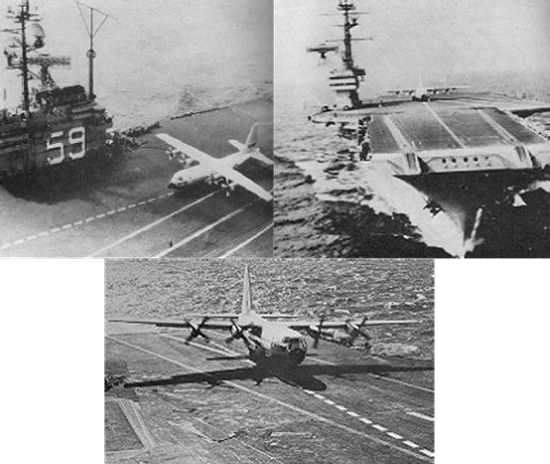
C-130 Aircraft Carrier landing


I would not have thought it possible, be here we see the photo proof that a C-130 can in fact land and take off from an aircraft carrier. This occurred on the USS Forrestal in 1963. It is to this day, the heaviest and largest aircraft landing and takeoff from a carrier. Amazingly, this USMC KC-130F, with a Navy Lieutenant at the helm, landed on the deck without the use of the arrester cables. The C-130 can change the direction of its propeller blades in order to slow the aircraft and land in a much shorter strip. The crew did this just prior to landing to decrease the space needed to stop the aircraft.  Records state that the Hercules made 29 touch and go landings, 21 full stop, unarrested landings and 21 unassisted (no steam catapult) take-offs. Landings and takeoffs were made at several weights from 85,000lbs to 121,00lbs. When at low weight, the Hercules was able to stop in 267 feet, only slightly more than double the wingspan! At the max tested weight, it only required 775 feet for takeoff and 460 feet for landing. This very aircraft was in fact, in service up until 2003 and is now on display at the National Museum of Naval Aviation in Pensacola, Florida. The Navy ultimately decided that the margin for error was too small for operational use and developed the C-2 Greyhound for the COD (Carrier On board Delivery) mission. 


For those that might doubt the veracity of my reporting on this matter, there is a Youtube video of a landing, but embedding was disabled so you will have to go to Youtube all by yourself to see it. 


Oooh look! Color photo of takeoff!

Thursday, April 19, 2012

Shi Lang, China's first aircraft carrier


The People's Liberation Army Navy (yes that is their real name) have begun sea tests of what may be their most powerful conventional warship. Although not officially confirmed, it is expected to be named Shi Lang, who was a successful Chinese admiral in the Ming and Qing Dynasties and led the invasion and conquest of the Kingdom of Tungning on the island of Taiwan in 1683. Which I might find worrisome if I lived on Taiwan today.

The keel for this ship was laid down all the way back in 1985 and was being built for the Soviet Navy as an Admiral Kuznetsov-class multi role aircraft carrier. Originally known as the Riga, she was later renamed the Varyag (Varangian) after a famous Russian Navy Cruiser. By 1992 all work on the ship had ceased, it was laid up and stripped. The ship was never finished by the Soviets and became the property of the Ukraine after the breakup of the Soviet Union. At this point, the "ship" lacked its engines, rudder, arresting cables and many other important systems.


Satellite photos of the Varyag undergoing refit

How did the the Naval Arm of the People's Republic of China obtain an aircraft carrier from the Ukraine? Well, the answer is more convoluted than you might think.
It started in 1998 when the Trade Minister of Ukraine announced the the Varyag had been sold for $20 million USD to Chong Lot Travel Agency, Ltd. Chong Lot has been described as a small travel company that is owned by Chin Luck (Holdings) Company of Hong Kong. According to the US Naval College Review, four of Chin Luck's six board members live in Yantai, China, which is the site of a major Chinese Navy shipyard. They also state that the chairman of the Chin Luck Co. former career military officer with the People's Liberation Army. What a curious coincidence.

But back to the deal. So this small travel company from Hong Kong buys a huge warship (well, some it anyway) and says that they are going to turn it into a floating luxury hotel and casino. Awesome, right? Their plan is to tow the hulk from the Black Sea through the Suez Canal and all the way to the port of Macao, a small semi autonomous island off southern China. The buyers at Chong Lot were told prior to this that the the Varyag would not be given a permit to berth in the harbor of Macao for the refit. But the sale and tow of the ship continued.


Varyag under tow


Problems continued to arise. In 2000, a Dutch tugboat company hired a Filipino crew to tow the ship to Macao. Then Turkey refused passage through the Bosporus Straits, allegedly because the ship posed a danger to the bridges and navigation of this important waterway. The hulk was then towed in circles for 16 months, while the PRC negotiated with (bribed) the Turkish officials. It is rumored that the decision was reversed when the Chinese delegation offered to let Chinese tourists visit Turkey and give it an infusion of tourist money. Call me cynical, but I imagine their were some under the table exchanges as well. At this point I asked myself: Why would the Chinese government negotiate with Turkey for a privately held Hong Kong casino boat? Well, they wouldn't. Obviously, all the "plans" for the Varyag were a sham and it was being acquired as a warship, under the control of the PRC military, from day one.

The vessel transited the straits in November 2001. In transit, the Varyag was towed by eleven tugs and three pilots, and accompanied by another 13 ships.


On November 3, Varyag was caught in a force 9 gale and broke adrift while passing the Greek island of Skyros. One tug managed to attach a line to the ship late in the day, but high winds severely hampered efforts by two other tugs to secure the ship. On November 6, Aries Lima, a sailor from the tug Haliva Champion, died after a fall while attempting to reattach the tow lines. On November 7, the hulk was taken back under tow and progress resumed. Since the Suez Canal does not allow passage ships without power, Varyag was towed the long way. Through the Strait of Gibraltar, down the west coast of Africa and around the Cape of Good Hope, across the Indian Ocean and through the Straits of Malacca. At 6 knots. For 15,200 nautical miles. A slow boat to China, indeed. The future Shi Lang docked at Dalian Shipyards, in China on March 3, 2002. At this point China was continuing the farce that the Varyag had been acquired for use as a casino and hotel. But when the Macao authorities awarded casino licenses, Chong Lot was not included. And the Varyag was sitting at the dock hundreds of miles away in a major military shipyard.


While designated an aircraft carrier by the West, the design of The Admiral Kuznetsov- class is different from the carriers of the West in several ways. First off, they are called Heavy Aircraft Carrying Cruisers in Soviet military terminology. They were designed with a vertical launch missile system right in the middle of the deck to fire twelve of the huge P-700 Granit supersonic anti ship missiles. These have the NATO reporting name of Shipwreck and can carry either a 1600 pound explosive warhead or a 500 kiloton tactical nuclear warhead. These are carrier sinking missiles and that is the primary function of the class- to destroy the capital ships and large carrier groups of the West, especially the US Navy. In larger part the class was designed to protect and support the missile subs and missile capable aircraft. Fixed wing flight operation are mostly limited to air superiority missions, as the Su-33 Flankers have only a limited air ground attack capability. Unlike US carriers, which place a premium on long range strike of enemy vessels and ground targets. Like other carriers, several helicopters would be carried and part of their mission would be to carry out anti submarine operations.


In the summer of 2005, the Varyag was moved to a dry dock and the serious work began. Scaffolding was built and the hull sandblasted. The island was given a coat of red marine primer to treat the degraded and corroded steel. The anti-ship missile tubes have been plugged and will not be used, thus freeing up more internal space for hangar or storage use. Russia reportedly plans to do the same when it modernizes the Varyag's sister Kuznetsov. Sensors that have been observed or expected are the Active Electronically Scanned Array(AESA) and Sea Eagle radar. Weapons observed onboard are the Type 1030 CIWS, and the FL-3000N missile system. However, it takes more than a big flat ship to make for effective Naval Aviation. To that end, the Chinese have built a scale training facility near Huangjia Lake in the southwestern suburbs of Wuhan at the Wuhan Naval Research site. So they have been practicing simulated carrier landings there since 2009. For those who worry a great deal about the economic and military rise of China, take heart. This ship will never be the equal of US carriers. For example, the Soviet Navy at the height of its power only carried 13 Su-33s onboard, although there is room for up to 33, at the expense of other craft, for a total of about 41 craft, well below a USN Nimitz-class. The air wing was rounded out with 5 Su-25 "Grach/Frogfoot" close air support jets and 24 Ka-27 utility helicopters. For aviation facilities, the class uses what is called STOBAR. It stands for Short Take Off But Arrested Recovery. The landing aircraft are stopped via one of four arrester cables and the take off area has a 13 degree "ski jump" bow. While the capabilities of the Admiral Kuznetsov-class are limited in some areas (like all ships) keep in mind that the Shi Lang may not share all those limitations. The Chinese have spent a great deal of time working on her for one thing. And while the Soviet/Russian Su-33s (the Naval version of the Su-27 "Flanker" Air Superiority fighter) are not gifted strike aircraft, it is entirely possible that they could be modified to perform the mission and what we might call F/A versions have already been designed. The PLAN has no doubt taken notice of the this as well.


.


It has taken the PLAN a long time to get the Shi Lang to sea and they still have a long way to go if they plan on making it a viable war ship. But it certainly represents a big step forward for the Chinese military in terms of technology, strategy and scope. I would be not be pleased if I lived the in Philippines.


Edit-- 10/25/12-- the PLA Navy has commissioned the ship under the name "Liaoning"