Friday, October 15, 2010

How to Fight a War


The U.S.S. Constitution (Old Ironsides) as a combat vessel during the War of 1812 carried 48,600 gallons of fresh water for her crew of 475 officers and men. This was sufficient to last six months of sustained operations at sea. She carried no evaporators (fresh water distillers). However, let it be noted that according to her log, "On July 27, 1798, the U.S.S. Constitution sailed from Boston with a full complement of 475 officers and men, 48,600 gallons of fresh water, 7,400 cannon shot, 11,600 pounds of black powder and 79,400 gallons of rum."

Her mission: "To destroy and harass English shipping."

Making Jamaica on 6 October, she took on 826 pounds of flour and 68,300 gallons of rum.

Then she headed for the Azores, arriving there 12 November. She provisioned with 550 pounds of beef and 64,300 gallons of Portuguese wine. On 18 November, she set sail for England.

In the ensuing days she defeated five British men-of-war and captured and scuttled 12 English merchantmen, salvaging only the rum aboard each.

By 26 January, her powder and shot were exhausted. Nevertheless, and though unarmed, she made a night raid up the Firth of Clyde in Scotland. Her landing party captured a whiskey distillery and transferred 40,000 gallons of single malt Scotch aboard by dawn. Then she headed home.

The U.S.S. Constitution arrived in Boston on 20 February 1799, with no cannon shot, No powder, No food, NO rum, NO wine, NO whiskey and 38,600 gallons of stagnant water.

Now those guys knew how to fight a war.


Now, for full disclosure, I found the above text on some board and have no proof whatsoever of its veracity. In all likelihood, it is grossly exaggerated or just plain made up.
But it does sound fun.

This Day in History - October 15

On this date in 1917, one of the most famous spies in history was executed.
Mata Hari was the stage name of a Dutch woman named Margaretha Geertruida Zelle. She became famous for, well to put it impolitely, kinda being a ho. She was a dancer known for performing "exotic" dances that seemed to consist of her wearing some kind of vaguely eastern costume and taking it off. She had a whole back story that she was born in an Indian temple and was taught sacred dances by the priestesses. However, it was all a pack of lies and what she knew of Indian and Javanese dances she learned while in Malaysia with her husband who was in the Dutch Colonial Army. But nobody knew or cared, because Internet porn was like, 70 years away. She was known as a famous courtesan, which is nice way of saying she was a gold digger. She was widely rumored to be banging( to use the parlance of our times) a bunch of high-ranking military officers both in the French and German armies. So, in 1917, the French authorities arrested her on suspicion of treason and espionage and sent her to the St. Lazare Prison in Paris. During her military trial, she was accused of revealing details of the new weapon, the tank, resulting in the deaths of thousands of soldiers. She was convicted and sentenced to death.

For 1917, this was wicked hot

Today, opinions are divided about the truth of the matter. Some say that she was a spy for the Germans and even worked as a double agent for the French, but that the Germans had written her off as pretty much useless. (except all the looking hot and dancing like a ho) Her trial was said to pretty much be a farce and no real evidence was brought against her. It has been suggested that the French High Command played her story up to distract the nation from the appalling losses that they French Army was suffering on the Western Front. No one will ever know the truth, I suspect. But the legacy is that Mata Hari became the archtype of the femme fatale spy, and we would probably not have any James Bond movies without her. In one of those incidents that is more like a movie than real life, she refused a blindfold and blew a kiss to her firing squad before she was shot.


Also in 1860 an eleven-year-old girl named Grace Bedell, wrote a letter to presidential candidate Abraham Lincoln, suggesting he could improve his appearance by growing a beard.

Multicam

Rare Weapons- 6P62 12.7mm


OK, this ugly mug is the 6P62. It is a Russian anti-materiel rifle that is fully automatic. The rifle is chambered in the 12.7x108mm cartridge, which is pretty similar, but more powerful than the US .50 BMG (12.7x99mm). I think the Russians caught whatever disease the Germans had that made them always build bigger and more ridiculous guns. This thing is a monster. It reportedly weighs close to 40 pounds when loaded with 14 rounds of 12.7mm, and I would guess that the muzzle brake weighs at least 3 pounds. The brake might also function a little like a suppressor, probably making this weapon about as quiet as the average 500 pound bomb. It has a listed range of 1000 meters or more and can reportedly pierce 20mm of steel at 100 meters. Of course a full auto function on a weapon like this is just silly, even if it is firing at the reduced rate of about 400--500 rounds per minute, which is slower than most automatic weapons I can think of.


The 6P62 was never put into full production, likely because someone sobered up. While it could be used in a fashion like the Barrett Light 50 and other big bore anti-materiel rifles, I have my doubts that it can perform as well. It has a fairly short barrel and I can't see that it is fluted to give it strength without undue weight. At the least I imagine the recoil is well, sharp. The gentleman firing it offhand above (why?) likely had some rotator cuff surgery and called it a day. Interestingly, both photos that can be found show it without a telescopic sight, which one would need to fire at anything smaller than a barn at the intended ranges. This might be because its recoil force would tear a scope meant for .30 caliber rifles to hell and back.

One possible use is for the weapon to be used at road blocks and from fortified positions to get the most use of a weapon with long range and the power to punch through light armor and cover, but heavy machine guns and grenade launchers are probably better suited to that role. While the 6P62 will likely never be seen anywhere but the Internet, it may have a descendant in the form of the KPB-12.7 rifle, for which there is even less information than the 6P62. If anybody knows more about either of these weapons, or please god, has video of some unfortunate soul firing one, please let me know. Also, I will use this as my standard long gun when I finally finish that Power Armor I am working on in the basement.
So get ready.

Marines love the Misfits


Nothing much to say about this one, it of course reminds me of all the images of soldiers and Marines from Vietnam with various sayings written on their helmets or flak jackets.
If you don't know the reference, it is from a song by the Misfits, a punk band, if you don't know them get a copy of Walk Among Us. It rocks.

Thursday, September 23, 2010

Exploded Views and technical drawings

I have always liked to look at the exploded view drawings of weapons both to gain a better understanding of how they work, and also to appreciate the amazing artistic talent of people who could plan out and execute such detailed drawings. So here are some neato pics.


Wednesday, September 22, 2010

The 2nd Amendment

Snap.

Backblast


At first when I saw this picture, I assumed that the wall near the soldier had been hit by an RPG or that a gunship was hovering and firing overhead. Or both. Or something. I don't know. Then other, more intelligent people pointed out that all the effects we see is simply caused by the back blast of the AT4 rocket launcher. It that caused all the chaos. And the really dangerous part was several hundred feet away.
Lesson: Don't stand behind anti-tank weapons though kids, because it will completely kill you. Just, you know, FYI.
It was enough to pick up all those empty shells, all that dust, and the M4, which was probably laying on the ground. So I am guessing that is an older model and not the newer one designed to be fired in enclosed spaces without breaking everyone around into little pieces and then having them breathe in the toxic exhaust.
Crazy stuff.

Monday, September 20, 2010

Airship drones


Awhile ago, I posted about the "Beast of Kandahar" in The Giant Blimp of Kandahar, which was suspected to be a long endurance, reconnaissance UAV. I found this pic a few days ago, and it seems to be the same aircraft. They both have a triple tail fin and similar overall shape. At the time, I guessed that it was a prototype or scale model of the Lockheed Martin LEMV. The caption just named it as the Persistent Surveillance System.

The earlier photo had no sense of scale, so I was pleased to get a closer look at "the Beast". As we can see, it is a pretty large maybe 40 feet or more, but that is much less than the reported 200 feet of the LEMV. Lockheed has understandably not released very much info on the LEMV, but they have hinted that it will be a UAV capable of staying aloft and using multiple technology to find and identify enemies. We can certainly assume it has powerful daylight, Nightvision and thermal cameras. It also might mount a magnetic anomaly detector for looking for IEDs or submarines or so forth, but that is just a blind guess on my part. It could also be used for things such as intercepting radio and satellite phone signals, or as a booster to send friendly communications. The one thing I am pretty sure of is that we will see more like it in the future.
Well, I don't really have any more info. I just thought it was a neat picture.

I can't tell, but I think this is not the same aircraft. Seems the nose and fins are shaped differently. But I felt bad for such a bare bones post, so I figured I would treat you, my beloved readers, to the fruit of a 3 second Bing image search. You are welcome.

Wednesday, August 25, 2010

Iconic Guns- Mauser 98

I have been waiting to write this one for awhile because I wanted to do it right. And I'm lazy. And I just got a Xbox 360. Yes, I know they have been out for a long time. It was a gift and I'm psyched.

The Mauser 98 is simply one of the most important firearm designs ever made. In terms of the importance and longevity of the design, it is like the Colt 1911 of rifles. It has only recently stopped being the basis of a huge amount every bolt action in production, and the best bolt action rifles of the 20th Century were almost all based on the Mauser 98 action, including the US Army's M24 sniper rifles and the USMC M40 series sniper rifles, which are still in service. The Remington 700, from which the M24 and M40 were developed, is based on the M98 action. The 700 is still a highly sought after weapon for hunters and marksmen, especially the early models. While the Mauser 98 was first produced in 1898 at Paul Mauser's factory in Obendorf, Germany, I am mostly going to be referring to the ultimate evolution of the design, the Karabiner 98 Kurz or K98k, the most common and smallest of the classic 98 line.


Mauser Karabiner 98 Kurtz with its basic equipment

When people talk about the Mauser 98, they are often just speaking about its action. The action refers to the physical mechanism that moves the cartridges and seals the breech in preparation for firing. The term is also used to describe the method in which cartridges are loaded, locked, and extracted. The Mauser system consists of a receiver that serves as the systems shroud and a bolt group. The body of the bolt has three locking lugs, two large main lugs at the bolt head and a third safety lug at the rear of the bolt which serves as a backup in case the primary locking lugs failed. This third lug was added to increase the safety of the rifle. Another important feature of the 98 is its feed mechanism.

M 98 controlled-feed bolt-action system: a = chamber, b = front main locking lugs recess,
c = receiver, d = internal magazine spring, e = ammunition stripper clip, f = bolt group,
g = firing pin, h = pistol grip.


The 98 possesses a large claw type extractor that holds on to the rim of the cartridge all through the process of chambering the round, firing, extraction and ejection. The bolt handle is straight and protrudes out on the Gewehr 98 and on later models it is turned down so that it is less in the way and can be manipulated more easily. The 98 cocks the firing pin when the breech is opened, unlike the SMLE for example which cocks on closing. There is a piece that sticks out both visually and to the touch to signify that the weapon is cocked, which has become standard on many guns today. The Mauser 98 also has a small metal disc set into the stock that functions as a bolt disassembly tool, which, along with an easy process for field stripping, allows the user to perform maintenance and even switch out broken parts in the field. In another design feature to increase the safety of the weapon, Mauser included a gas shield and two large relief holes to the bolt sleeve. these were there to channel the hot, high pressure gas and bits of hot, sharp, jagged metal away from the face in the event of a catastrophic failure. (Should it happen to blow up)


K98k Mausers with rifle grenade and bayonet


7.92x57mm rounds (8mm Mauser) on stripper clip


While the 8mm Mauser cartridge has largely fallen out of favor in recent years, it is a very capable cartridge whether for military or civilian use. It fell out of favor as the arms world coalesced into NATO and Warsaw Pact standard calibers in the 1960s. It is in no way obsolete and the Russians and many others still use the less advanced (rimmed) and older 7.62x54R cartridge to very great effect. The first M98s were chambered in a 8.07mm diameter bullet, and was switched to a larger but lighter 8.2mm bullet with a new pointed shape called the Spitzer bullet. Many different loadings of the 8mm were made from its adoption by the Imperial German Army in 1898 to the Nazi build up of forces in the mid 1930s and throughout WWII. The original load pushed a 226 grain Spitzer bullet at 2,095 feet per second. By 1935, this had been changed to a lighter 197 grain bullet with the velocity increased to 2,493 FPS, giving it a flatter trajectory and a slightly longer effective range.


The end result was a rifle that was light (relatively) very accurate and capable of a very high rate of fire. The Mauser had better accuracy, safety, and quality of workmanship than any other weapon of the era. The Mauser was in many ways the premier rifle of its day and was only really equaled by the SMLE and probably only surpassed by the Springfield 1903A3 (by virtue of its updated and superior sight), which was a Mauser design itself. Weapons designed around variants of the Mauser 98 action continue to see vast civilian and specialist military use more than 100 years after is debut. It has been used by many countries, and you can find surplus 98s all over. There are thousands of Yugoslavian Mausers made on the German machines right after WWII that can be had pretty cheaply, many of them in new, unissued condition. According to Mauser Military Rifles of the World, by Robert W.D. Ball, 54 different countries contracted with Mauser to make more than 1,000 models of the basic rifle from 1871 to 1945. From Argentina to Yemen, Mauser rifles served on the front lines of nearly every conflict of the 20th Century.


The Mauser 98 and its descendants have clearly made their mark on the history of firearms design and warfare. Millions of Mauser 98 type weapons have been made. If you count guns that have an action that is a copy or descendant of the 98, who knows how many there are. That is just how important the M98 is to the history and design of rifles. The only real deficiency to the design is that it is fairly expensive to produce and needed a lot of skilled people to make it right. But that is really just a hallmark of the meticulous and exacting nature of German design. Certainly it has been used by many others than the Germans, though. Today you can still find many examples Persian, Chilean, Argentinian, and Yugoslavian Mausers just to name a few. The Israelis used a number of K98ks in their War of Independence. They have been chambered in several different cartridges, some of which are very hard to find today.


Tuesday, August 24, 2010

Iranian Midget Submarine


Well, from Iran's terrible taste in camouflage and their imminent status as a nuclear power, we move to Iranian Naval power. The above is the Ghadir-class midget submarine. The powers that be in Iran have sought for several years to find a way to fight the Navies of the West, especially the US, in the waters near Iran. Despite the rather huge disparity in Naval power, the Iranians have several advantages in this theoretical battle. The waters of the Persian Gulf are relatively shallow and busy, making it harder for big subs to hide and hard for them to use acoustic methods to search for enemy subs. Also, in a potential conflict, the West must not only defeat the Iranians, but also keep open the vital sea lanes and prevent an ecological disaster from destroyed oil infrastructure. Whereas the Iranians would have a major victory in the eyes of many if they are able to sink even a few Western warships.


Well, to the specifics of this craft. The Ghadir is a class of midget diesel/electric submarines manufactured in Iran. It is fairly accepted that despite the Iranian propaganda machine's claim that the sub was designed by Iranian engineers, the sub was built from North Korean plans and with their technical expertise. And before we snicker into our hands about our friends the North Koreans, keep in mind that they were able to sink a South Korean corvette, the Cheonan, with a similar sub.

The Ghadir is named after Ghadir Khumm a Shiite holy site in Saudi Arabia.

There are 11 Ghadirs in service and more on the way, with new subs delivered in 2009 and 2010. They are about 90 feet long and have a crew complement of 18. While the sonar and sensors and so forth are unknown at this time, we can probably expect them to be based on older Russian and Chinese equipment, like most of the Iranian arsenal. The Iranian state-owned media claims that the subs are "stealth" and capable of evading sonar, but I am going to chalk that up with other, similarly wild claims about the indigenous weapons from Iran. The sub has two torpedo tubes and could likely only carry two torpedoes. It has been said that the Ghadir can also fire tube launched missiles. While the Ghadir is not the state of the art, it could still be a formidable weapon, especially employed in groups. Recently, a war game showed that swarming tactics using small, fast, torpedo and anti-ship missile armed boats could be a serious threat to a US Carrier Group. However, the US Navy is pretty much the world master in anti-submarine warfare, and in any kind of large scale combat, I would expect the loss rate of this little sub to be very high. If it was located, its chance of getting away is small, and if hit with any modern ASW weapon, it would likely sink in a minute or two, if it was not immediately torn in half. Its only hope is that its size could help it hide in shallow water. The Ghadir and the North Korean Yono-class are not to be underestimated, but you wouldn't get me into one. It is apples and oranges, but no Japanese midget subs survived the attack on Pearl Harbor, and that was hardly the best day for the US Navy.

North Korean Yono-class submarine

Worst Camo Evar


OK, Next person who bitches about the US Army UCP (ACU) camouflage pattern has to wear this.
This is an Iranian pattern, and it is apparently known as the "ice cream paint job pattern". It is the worst camo pattern known to man. (Excluding the fashion patterns in red and orange and pink and so forth) I mean, what were they thinking? It could possibly be an OK pattern for a snowy environment, but in the desert? Really? I also like how his uniform is slovenly and un-military like when guarding the most important site in his country AND getting his picture taken by the media.


Man, it sure is easy to make fun of some people. Of course, what is not funny is that this unfortunately dressed soldier is guarding a Nuclear plant at Bushehr which will soon make Iran a nuclear armed nation. To believe that is not the goal of their program is frankly, amazingly stupid. The rest of the world (US EU, Saudi Arabia and everyone else who really does not want a Nuclear Iran) probably should have simply paid the Israelis to destroy the Iranian nuclear program. Or joined them in a false-flag operation. Why them? Well, they would like to do it and the Iranians couldn't hate them any more than they already do now could they?

Saturday, July 31, 2010

Dog Heroes

Here is one of those heart warming stories for you. The dogs you see above may not be as fast as a Doberman, as strong as a Pit bull or as smart as a German Shepard, but they have earned a spot at the Ruth's Chris table if you ask me.

On February 11, 2010 a suicide bomber attempted to enter a barracks building housing US Army personnel. As he tried to enter, he was attacked by Rufus, Target and Sasha. The attack forced the bomber to detonate his bomb in the corridor, instead of the other areas with more soldiers.
The bomb wounded five soldiers and killed Sasha. However, the actions of a trio of rather unimpressive-looking dogs saved the lives of many, if not all of those soldiers.

On July 29, Pet Airways flew Rufus and Target to the USA were I hope they will be fed large amounts of whatever dogs think is awesome.


Sgt. Christopher Duke meets Rufus and Target at the gate

Greatest guns of Fiction- Plastic Gun


This one is the gun used by rogue CIA agent Mitch "Booth " Leary in the 1993 film In the Line of Fire. In the film, Leary, played by John Malkovich at his least irritating, plots to assassinate the President of the United States and plays a cat and mouse game with Clint Eastwood's character, a disgraced Secret Service agent who failed to save JFK. Spoilers are ahead for those who haven't seen the movie. It is pretty good, so watch it and come back. Leary constructs an elaborate plan to defeat the layers of Secret Service protection, including posing as a rich businessman with thousands of dollars to give to the President's reelection campaign. Genius.


But we are here to talk about guns, so lets get to it. Malkovich's character is said to be a former CIA assassin who is skilled in model making. It is this model making skill that allows him to build a unique weapon to use for the job. The gun is a double barrel, single action weapon. From the size of the bore and what I remember from the movie, it seems like it would be chambered in 9mm NATO or .380 ACP. Each barrel is manually cocked by the levers at the top of the weapon. . As near as I can tell the weapon is almost completely constructed out of some type of composite material in order to let Booth sneak it past the metal detectors. You would likely still need several metal parts, namely springs for the trigger and bolts, and a firing pin. The firing pin could be an off the shelf titanium firing pin, used in many weapons today. If I recall high school chemistry correctly, titanium is paramagnetic and would therefore not set off most metal detectors.

Could you make a weapon out of non-metallic composites? Well, maybe. If you did not plan on firing it more than a few times, used low pressure ammunition and perhaps did some engineering and computer modeling work to understand the forces and materials involved, it just might work. Then again, it might mangle your fingers. let me put it this way, I wouldn't try it. One of the biggest hurdles would be the barrel. We know that you can certainly make a great deal of a gun out of plastics, but the barrel and chamber would be pretty difficult to engineer. They are both subject to very high temperatures and intense pressure. Carbon fiber or some type of non magnetic alloy could be used but that is probably beyond the home workshop, especially in the early 90s. Since the weapon was intended to be used at point blank range, you could probably get away with an non rifled barrel, but it would likely cause the bullet to fail to reach its maximum velocity, impeding its effectiveness.


The weapon also breaks down into several sections and he stores the ammunition in a hollow key chain. Pretty clever, and it might just escape the notice of security personnel. The film also has references to three of the four historical Presidential assassinations. Clint Eastwood's character was a Secret Service Agent protecting JFK the day he was assassinated. Leary refers to himself as "Booth" for much of the film, referencing John Wilkes Booth, Lincoln's killer. In the end of the movie, Leary attempts to shoot the President through a napkin, which is what Leon Czolgosz did when he killed William McKinley.

Fun fact, the makers of the film were worried enough about the legality of the PROP that they had it cut into sections after filming. I suppose to prevent it being modified to fire.
(I would let you shoot it first)

Friday, July 30, 2010

Media Manipulation


Its important to to remember that the media, in its Corporate form, is a profit driven business. They create profit by creating interest. Interest is created by controversy, real or manufactured. Non-traditional media like blogs or state-owned media are there pretty much to promote a certain viewpoint. Please be intelligent and read between the lines, get your news from more than one source, maintain a sense of scepticism, demand proof, and use common sense.

Rant ended.
Carry on.

HESCO Bastions

From the extremely high tech world of rockets, missiles, and space flight, we will now take a turn for the primitive. What is known as the HESCO barrier or HESCO bastion is quite possibly one of the simplest and most effective systems in use today by the military. There is a great need to make bases relatively safe, especially from small arms, grenades, and rockets, as well as the shrapnel of other weapons like mortars. Classically, soldiers hand filled sand bags for use as protective fortifications. This worked okay from a protection point of view, but was extremely labor intensive. You can only fill so many sand bags in a given period and if you are trying to fortify a large FOB or airbase, it would take a real long time. Then, someone invented this:


This is the HESCO Bastion, originally designed as a temporary or semi-permanent flood control structure. They were used to reinforce levees after Hurricane Katrina. In 2008, during the extensive flooding in the Midwest, 27,000 feet of HESCO barriers were shipped to Iowa and set up. Today they are used on almost every US and NATO base in Iraq and Afghanistan. They are made up of a collapsible wire mesh "wall" with a thick synthetic fabric liner. The name comes from the British company that invented them more than 10 years ago. The real name of the product is the "Concertainer" playing on the classic concertina wire barrier. HESCO is actually the name of the company that produces it. In general use, they are often simply called Hescos.


The HESCO first began to be used in the security context in the 1990s. They can be stacked two or three high and make a formidable barrier for weapons. They are very cheap and can be assembled by people with little or no training. The are shipped collapsed and weigh very little. The Hesco comes in several sizes, dimensions of typical configurations are 4’6” x 3’6” x 32’ to 7’ x 5’ x 100’.

Protecting the most important part of the base

One of the best features of the the HESCO is the ease in which it is set up. Get it flown in or pull it off a truck, unfold it, use a front end loader or other heavy equipment to fill it up with dirt, sand or gravel. It is not instantaneous, but the speed that it can be set up in is pretty impressive. One soldier operating a front end loader and four more unfolding the shells can set up a wall in just couple of hours. They can essentially work ten times faster than crews filling sandbags. There is a new system of set up where the barriers are loaded in the back of trailer and dropped out in a line, a few people following behind set up them up and the loader filling them. This way a wall several hundred feet long can be in place in minutes and finished in a day.


Of course the real question is how effective is the HESCO bastion as a fortification? Well one answer is below. This is a Hesco that was hit by a rocket propelled grenade. You know, the things that can destroy armored vehicles.


When filled with sand, a barrier that is 24 inches think will stop almost all small arms projectiles and shell fragments. Given the very deep penetration of shaped charge weapons, guidelines state that for protection against RPGs, the barriers should be at least 5 feet thick. So based on that, we can see that the HESCO bastions, appropriately placed, would likely be a very good protector against several of the most common weapons on the battlefield. Even though the bases are still vulnerable to high angle attacks such as mortars and RPGs being used as rocket artillery, placement of bastions inside the base can greatly diminish the blast area by containing it. By the same studies' findings, car bombs (or VBIEDs if you prefer acronyms) can usually be defeated with 4 feet think sand filled barriers. I say usually, because you could have some really large bombs (like Oklahoma City) if you have the resources and motivation. Very little could impede a blast like that.

So there you have it. Cheap, easy and very fast to set up, fairly impervious to the elements, and will stop bullets, bombs and rockets. I like solutions like this and who ever thought the HESCO bastion up, that guy needs a medal. Or at least a beer.

Norwegian base surrounded by Hescos, note the barriers in between the tents to stop mortar and rocket fragments.


Tuesday, July 27, 2010

Guns


I lesson I learned a long time ago, thanks to Dr. Jones

Monday, July 26, 2010

Marshall Space Flight Center

I recently took a trip to "Rocket City" or Huntsville, Alabama. In Huntsville is the George C. Marshall Space Flight Center. The MSFC is the original home of NASA and the site of some of the most innovative science and engineering work that ever been accomplished.
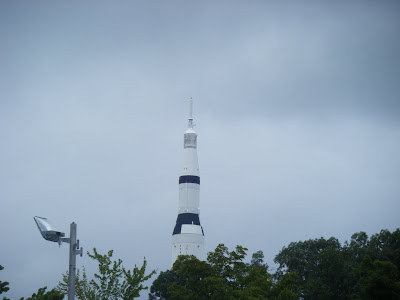

So, In case you were not aware, the Saturn V rocket is HUGE.


That building behind it is about 6 stories tall.

The Space Flight Center is located on the Redstone Arsenal, an Army base that was established in 1941 and was mainly used as a chemical weapons production and storage facility. The MSFC is the lead center for NASA's work on the International Space Station design and assembly, responsible for payloads and crew training, the Space Shuttle propulsion systems and its external tank, and NASA computers and networks. Also at the center is the Huntsville Operations Support Center (HOSC). The HOSC supports ISS and Space Shuttle launch, payloads and experiments. The HOSC also monitors rocket launches from Cape Canaveral Air Force Station whenever a Marshall Center payload is on board.

Also, Space Camp is there. I was really jealous of kids who got to go to Space Camp when I was a kid, but I am not as bitter now, mostly because I found out that they didn't really go into space like in the movie. Stupid rich kids.

There was a huge building dedicated to the Space Program and especially the Apollo program, the Saturn V rocket and the Lunar landings. Below is Command Module Casper of the Apollo 16 mission, the second to last NASA flight to the Moon.


Seeing a skyline of rockets makes one think they are in a 1950's Sci Fi comic


Another Saturn V, laid out lengthwise and broken into its various stages


Concept design for the new Orion crew capsule


How about this. Regular viewers of the History and Military channel may recognize the concept design for the Future Warrior program that they talked about so much a few years ago. It was really just an airsoft outfit in black with a motorcycle helmet and a foam gun. Somebody got paid millions of dollars to talk about what they wanted to make, then they turned in this piece of crap and got a huge amount of Federal dollars. Then they cancel the program before it produces a viable product. They could pay me to do this job for much less, I bet. It is kinda cool though.


The Space Flight center had a great display of current and former rocket based weaponry of the US Armed Forces in their "Rocket Park".


The AN/TWQ Avenger is a specialized turret mounted on a Humvee chassis for use as air defense platform. Above you can see the Stinger Missile pods and .50 caliber machine gun on the back of a Avenger. The Avenger can be linked to the Forward Area Air Defense Command, Control, Communications and Intelligence (FAAD C3I) system, which permits external radar tracks and messages to be passed to the fire unit to alert and cue the gunner. The government deployed Avengers to the White House around the first anniversary of 9/11. They have also been modified for use in Iraq as convoy protecting gun trucks.

This is the MIM-72 Chaparral, another air-defense platform, this time based on the M113 APC chassis and mounting four missiles based on the AIM-9D Sidewinder air -to-air missiles. The US forces have never used the Chaparral in combat, although it has been used by US Allies. It is now retired from use by the US Armed Forces.


Here we have the Hawk , designed as a medium range anti-air missile. It was in service for more than 40 years in the Army and apparently being phased out of Marine Corps inventories, but I would imagine that they are pretty much gone by now. The Hawk system, consisting of the launcher, missiles and a variety of different radars and control stations has been improved many times and the system was used to good effect in several conflicts. In 1973, Israeli forces launched 75 Hawk missiles and are credited with destroying between 12 and 24 aircraft. Kuwaiti Hawk batteries claimed 14 Iraqi planes shot down in Iraq's August 1990 invasion. Two of those kills have been confirmed, a MiG-23BN and a Su-22.


Going even further back, we have the Nike Hercules missile, a multi-role, two-stage solid propellant missile introduced into service in 1958. It was used in the high and medium altitude air defense role by the US and its NATO allies. It was also possible to use the Nike Hercules as a surface to surface missile. The Nike H was optimized for shooting down bombers and when it ballistic missile technology superseded the nuclear armed bomber, the Nike H became less useful. All the missile sites were deactivated in the CONUS by 1974, except for a few in Alaska and Florida. The Army continued to use truck mounted Nike Hercules systems as a front line air defense platform until the early 1980's when they began to be replaced by the Patriot Missile System. Most other NATO Nike units were disbanded with the fall of the Soviet Union.


This is the M270 MLRS, the Multiple Launch Rocket system. It is one of the most powerful and long ranged conventional weapons in the US Army's inventory. It is a rocket artillery system and is capable of sending its 12 270mm rockets to a range of 42 miles in 60 seconds. One MLRS firing all 12 rockets can completely blanket one square kilometer with submunitions. As a result the M270 is sometimes referred to as the "Grid Square Removal Service" As standard metric maps are divided up into 1km grids. It also fires the ATACMS (Army Tactical Missile System) which is ballistic missile capable of reaching out to 186 miles, with the warhead going as high as 164,000 feet. The MLRS has been in use since 1983 and seen use in Iraq and Afghanistan. 1,300 M270 systems have been manufactured, along with more than 700,000 rockets. The missiles can carry a variety of payloads, many of them using smaller submunitions. This kind of attack is very devastating to airfields, marshaling areas and exposed troops. During the Gulf War, the Iraqi soldiers were said to refer to the M77 submuntions as "Steel Rain." The M270 is no longer in production, with the last units produced in 2003 sold to the Egyptian Army. MLRS has been somewhat superseded in US service by the HIMARS, a lighter, C-130 transportable, wheeled version that only mounts one "six pack" of missiles


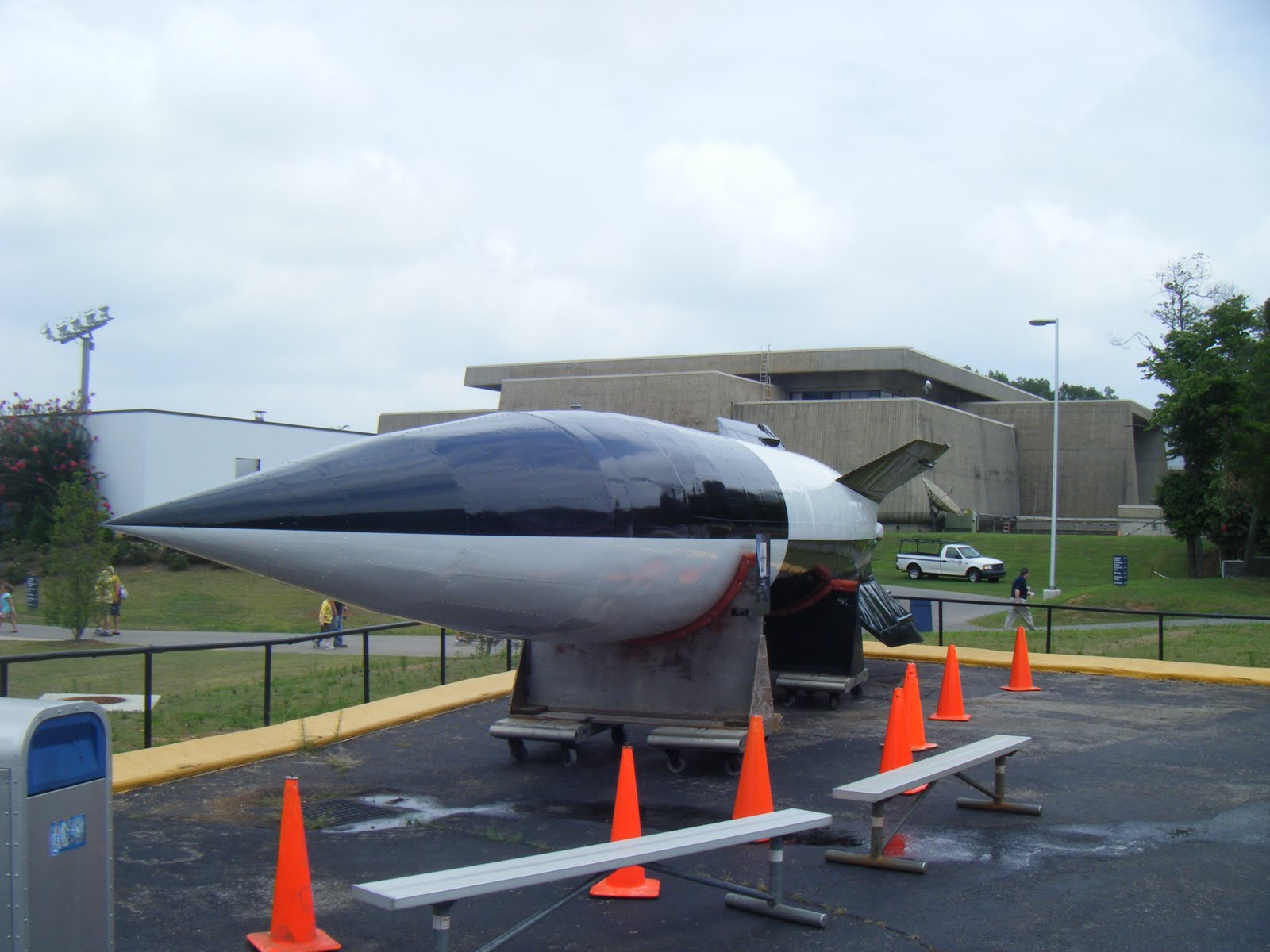
Of course, it is interesting to remember the source of space flight and the space programs that it came from. It was all started by Werner Von Braun and the German rocket scientists who used rocketry to kill thousands of civilians at the behest of Adolf Hitler. In the closing days of WWII, the Allies competed for the German prototypes, plans and especially scientists. Above you can see a V1 Buzzbomb, the first cruise missile. In total, the V-1 attacks caused 22,892 casualties (almost entirely civilians). One could try to be optimistic and think that the Teflon, Tang and satellite navigation that we have gotten from the space program has made up for the deaths, but, since we still have thousands of ICBMs, I think the jury may still be out. That said, I believe that the space program is one of the most amazing things America has ever done and it is of the utmost importance that we continue to move forward with space exploration.

German V2/A4 rocket, the first man made object to reach sub orbital space.
It was the foundation of both US and Soviet space programs


Original plans for the V2, detail photo below


Captured by the US Army's 76th Infantry Division