random mutterings about military history, firearms, preparedness, military technologies, and whatever else I feel like talking about. but not zombies anymore because the hipsters ruined them & now they have jumped the shark.
Tuesday, July 17, 2012
M56 Scorpion SPAT
This is the M56 Scorpion SPAT or Self Propelled Anti Tank Gun. It was produced for the US Army from 1953 to 1959 by the Cadillac Motor Car Division of General Motors and intended to arm Paratroopers and other light infantry formations with a light and highly mobile system to engage enemy armor.
It mounted a very capable 90mm gun, very similar to the one used on the M48 Patton tanks used in that era. 29 rounds for the gun were carried on board. The gun had a maximum range of 1,500 yards. The vehicle weighed in at 14,000 pounds and could be air dropped from fixed wing aircraft or set in place via a helicopter sling load. The engine was a gasoline powered Continental 200 horsepower, capable of a range of 140 miles and speeds up to 28 miles per hour. The gun was operated with a crew of four: commander, gunner, loader and driver.
The M56 Scorpion served in the 82nd and 101st Airborne Divisions, seeing service in the Vietnam War as fire support platform. It was replaced by the M551 Sheridan light tank.
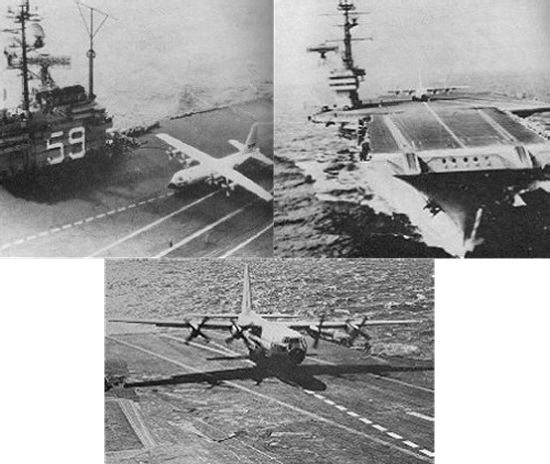
C-130 Aircraft Carrier landing
I would not have thought it possible, be here we see the photo proof that a C-130 can in fact land and take off from an aircraft carrier. This occurred on the USS Forrestal in 1963. It is to this day, the heaviest and largest aircraft landing and takeoff from a carrier. Amazingly, this USMC KC-130F, with a Navy Lieutenant at the helm, landed on the deck without the use of the arrester cables. The C-130 can change the direction of its propeller blades in order to slow the aircraft and land in a much shorter strip. The crew did this just prior to landing to decrease the space needed to stop the aircraft. Records state that the Hercules made 29 touch and go landings, 21 full stop, unarrested landings and 21 unassisted (no steam catapult) take-offs. Landings and takeoffs were made at several weights from 85,000lbs to 121,00lbs. When at low weight, the Hercules was able to stop in 267 feet, only slightly more than double the wingspan! At the max tested weight, it only required 775 feet for takeoff and 460 feet for landing. This very aircraft was in fact, in service up until 2003 and is now on display at the National Museum of Naval Aviation in Pensacola, Florida. The Navy ultimately decided that the margin for error was too small for operational use and developed the C-2 Greyhound for the COD (Carrier On board Delivery) mission.
For those that might doubt the veracity of my reporting on this matter, there is a Youtube video of a landing, but embedding was disabled so you will have to go to Youtube all by yourself to see it.
Thursday, April 19, 2012
Shi Lang, China's first aircraft carrier

The People's Liberation Army Navy (yes that is their real name) have begun sea tests of what may be their most powerful conventional warship. Although not officially confirmed, it is expected to be named Shi Lang, who was a successful Chinese admiral in the Ming and Qing Dynasties and led the invasion and conquest of the Kingdom of Tungning on the island of Taiwan in 1683. Which I might find worrisome if I lived on Taiwan today.
The keel for this ship was laid down all the way back in 1985 and was being built for the Soviet Navy as an Admiral Kuznetsov-class multi role aircraft carrier. Originally known as the Riga, she was later renamed the Varyag (Varangian) after a famous Russian Navy Cruiser. By 1992 all work on the ship had ceased, it was laid up and stripped. The ship was never finished by the Soviets and became the property of the Ukraine after the breakup of the Soviet Union. At this point, the "ship" lacked its engines, rudder, arresting cables and many other important systems.
How did the the Naval Arm of the People's Republic of China obtain an aircraft carrier from the Ukraine? Well, the answer is more convoluted than you might think.
It started in 1998 when the Trade Minister of Ukraine announced the the Varyag had been sold for $20 million USD to Chong Lot Travel Agency, Ltd. Chong Lot has been described as a small travel company that is owned by Chin Luck (Holdings) Company of Hong Kong. According to the US Naval College Review, four of Chin Luck's six board members live in Yantai, China, which is the site of a major Chinese Navy shipyard. They also state that the chairman of the Chin Luck Co. former career military officer with the People's Liberation Army. What a curious coincidence.
But back to the deal. So this small travel company from Hong Kong buys a huge warship (well, some it anyway) and says that they are going to turn it into a floating luxury hotel and casino. Awesome, right? Their plan is to tow the hulk from the Black Sea through the Suez Canal and all the way to the port of Macao, a small semi autonomous island off southern China. The buyers at Chong Lot were told prior to this that the the Varyag would not be given a permit to berth in the harbor of Macao for the refit. But the sale and tow of the ship continued.
Problems continued to arise. In 2000, a Dutch tugboat company hired a Filipino crew to tow the ship to Macao. Then Turkey refused passage through the Bosporus Straits, allegedly because the ship posed a danger to the bridges and navigation of this important waterway. The hulk was then towed in circles for 16 months, while the PRC negotiated with (bribed) the Turkish officials. It is rumored that the decision was reversed when the Chinese delegation offered to let Chinese tourists visit Turkey and give it an infusion of tourist money. Call me cynical, but I imagine their were some under the table exchanges as well. At this point I asked myself: Why would the Chinese government negotiate with Turkey for a privately held Hong Kong casino boat? Well, they wouldn't. Obviously, all the "plans" for the Varyag were a sham and it was being acquired as a warship, under the control of the PRC military, from day one.
The vessel transited the straits in November 2001. In transit, the Varyag was towed by eleven tugs and three pilots, and accompanied by another 13 ships.

On November 3, Varyag was caught in a force 9 gale and broke adrift while passing the Greek island of Skyros. One tug managed to attach a line to the ship late in the day, but high winds severely hampered efforts by two other tugs to secure the ship. On November 6, Aries Lima, a sailor from the tug Haliva Champion, died after a fall while attempting to reattach the tow lines. On November 7, the hulk was taken back under tow and progress resumed. Since the Suez Canal does not allow passage ships without power, Varyag was towed the long way. Through the Strait of Gibraltar, down the west coast of Africa and around the Cape of Good Hope, across the Indian Ocean and through the Straits of Malacca. At 6 knots. For 15,200 nautical miles. A slow boat to China, indeed. The future Shi Lang docked at Dalian Shipyards, in China on March 3, 2002. At this point China was continuing the farce that the Varyag had been acquired for use as a casino and hotel. But when the Macao authorities awarded casino licenses, Chong Lot was not included. And the Varyag was sitting at the dock hundreds of miles away in a major military shipyard.

While designated an aircraft carrier by the West, the design of The Admiral Kuznetsov- class is different from the carriers of the West in several ways. First off, they are called Heavy Aircraft Carrying Cruisers in Soviet military terminology. They were designed with a vertical launch missile system right in the middle of the deck to fire twelve of the huge P-700 Granit supersonic anti ship missiles. These have the NATO reporting name of Shipwreck and can carry either a 1600 pound explosive warhead or a 500 kiloton tactical nuclear warhead. These are carrier sinking missiles and that is the primary function of the class- to destroy the capital ships and large carrier groups of the West, especially the US Navy. In larger part the class was designed to protect and support the missile subs and missile capable aircraft. Fixed wing flight operation are mostly limited to air superiority missions, as the Su-33 Flankers have only a limited air ground attack capability. Unlike US carriers, which place a premium on long range strike of enemy vessels and ground targets. Like other carriers, several helicopters would be carried and part of their mission would be to carry out anti submarine operations.

In the summer of 2005, the Varyag was moved to a dry dock and the serious work began. Scaffolding was built and the hull sandblasted. The island was given a coat of red marine primer to treat the degraded and corroded steel. The anti-ship missile tubes have been plugged and will not be used, thus freeing up more internal space for hangar or storage use. Russia reportedly plans to do the same when it modernizes the Varyag's sister Kuznetsov. Sensors that have been observed or expected are the Active Electronically Scanned Array(AESA) and Sea Eagle radar. Weapons observed onboard are the Type 1030 CIWS, and the FL-3000N missile system. However, it takes more than a big flat ship to make for effective Naval Aviation. To that end, the Chinese have built a scale training facility near Huangjia Lake in the southwestern suburbs of Wuhan at the Wuhan Naval Research site. So they have been practicing simulated carrier landings there since 2009. For those who worry a great deal about the economic and military rise of China, take heart. This ship will never be the equal of US carriers. For example, the Soviet Navy at the height of its power only carried 13 Su-33s onboard, although there is room for up to 33, at the expense of other craft, for a total of about 41 craft, well below a USN Nimitz-class. The air wing was rounded out with 5 Su-25 "Grach/Frogfoot" close air support jets and 24 Ka-27 utility helicopters. For aviation facilities, the class uses what is called STOBAR. It stands for Short Take Off But Arrested Recovery. The landing aircraft are stopped via one of four arrester cables and the take off area has a 13 degree "ski jump" bow. While the capabilities of the Admiral Kuznetsov-class are limited in some areas (like all ships) keep in mind that the Shi Lang may not share all those limitations. The Chinese have spent a great deal of time working on her for one thing. And while the Soviet/Russian Su-33s (the Naval version of the Su-27 "Flanker" Air Superiority fighter) are not gifted strike aircraft, it is entirely possible that they could be modified to perform the mission and what we might call F/A versions have already been designed. The PLAN has no doubt taken notice of the this as well.
.

It has taken the PLAN a long time to get the Shi Lang to sea and they still have a long way to go if they plan on making it a viable war ship. But it certainly represents a big step forward for the Chinese military in terms of technology, strategy and scope. I would be not be pleased if I lived the in Philippines.

Edit-- 10/25/12-- the PLA Navy has commissioned the ship under the name "Liaoning"
Thursday, March 29, 2012
Sterling 7.62 NATO
Just the other day I found out about this prototype. There is not a lot of information available for it and I imagine that very few were made. The consensus is that it was developed as a potential replacement for the L4 Bren LMG. The Cold War era Sterling 7.62mm was also supposedly developed for its ease of construction and low cost compared to the Bren gun and other light machine guns. As WWIII never happened (at least the way everyone planned it) they were never needed.
It is constructed using a Sterling submachine gun trigger group and grip and could use FAL or L4 Bren magazines. In one of the pictures above you can see the weapon with what looks like a proprietary stock. The weapon reportedly used a lever-delayed blowback action to deal with the problem of switching from a pistol caliber blowback action which would be unsafe with the much more powerful 7.62x51mm cartridge. I imagine that it had a great deal of recoil anyway. Others have speculated that the rate of fire would be very high, but that might have been offset by a very heavy bolt or the action of the delayed blowback system. Since the parts all recoil in a straight line, felt recoil might be less than expected, but more in way that it would recoil and be "walked" back down onto the target. I would like to see a modernized version or a version chambered in the cartridge that could have been, the .280 British. I always like finding out about weapons that I've never heard of, even if it was a dead end in weapon design. It is a neat concept and you are not going to see one of these anytime soon.
Tuesday, March 27, 2012
Monday, March 26, 2012
Negev NG7 7.62mm LMG

Here we have the recently announced Negev NG7 light machine gun from Israel Weapon Industries (IWI), the privatized successor to IMI, the state owned weapons company of Uzi and Desert Eagle fame. It is a derivative of the popular and combat proven Negev 5.56mm LMG, sharing at least 80% of the same parts. The NG7 was designed with Special Operations forces in mind that need a lot of firepower in a package that is as small and light as possible. The IDF has long used the famous FN MAG machine gun (called the M240 in US service), but like many users they found that the MAG was very long and almost prohibitively heavy at around 30 pounds. The NG7 also features a semi automatic mode for the ability to fire single shots for increased accuracy. Several sources have noted that the NG7 is the only 7.62 GPMG or LMG with this capability, but the German MG 34 had this ability as well through virtue of trigger with two different "pulling surfaces". The Negev seems like it will fill its role nicely, it is exceptionally lightweight weighing in at about 17 pounds. It can be fired from a variety of mounts, including pintle mounts on helicopters, land vehicles, and naval vessels.
The Negev is just about the same as the 5.56mm Negev in terms of furniture and operation. Tritium night sight inserts are attached to the iron sights. It has an optional buttstock that is foldable and adjustable for length of pull with a cheek riser. It retains the somewhat odd Negev foregrip which is detachable and sits angled at about a 45 degrees to the axis of the bore. The NG7 has a two position gas regulator that allows the weapon to continue to work, even when it has become fouled. It is fed from a the left side with a disintegrating belt or with a box magazine fed from the top down. It is stated to fire from the open bolt position which is normal for light machine guns, but I wonder if it has a closed bolt for semi auto firing like the FN offering to the USMC Automatic Rifle competition. The NG7 has a Picatinny rails on the top cover for the attachment of optics and on the foreend for laser aiming devices.
“The new NEGEV NG7 represents the next generation of NEGEV LMGs – providing improved ergonomics as well as increased component reliability. These advances, together with its unique characteristics, make it the most effective lightweight 7.62 available for infantries. As with all other weapons built by IWI, it was developed together with the Israel Defense Forces (IDF). The close cooperation between IWI and the Israeli army in the development of new weapons – and the testing of these weapons on the battlefield by the IDF – is one of the most important factors contributing to the success of our weapons among armies around the world. The NG7 is already generating interest among our customers, and we have received many requests to test it. We are certain that it will become an important part of our product line.” -----Uri Amit, CEO of IWI

IWI NEGEV NG7 Weapon Specs (from Data Sheet):
Models: NEGEV NG7 LMG, NEGEV NG7 LMG SF
Caliber: 7.62x51mm
Operation: Open bolt, gas impact on piston head, rotating Bolt
Firing Modes: Safe, Semi-auto, Auto
Feeding System: Box, Assault Drum Belt Feed
Assault Drum Capacity: 100, 125 rds.
Barrel Rifling: 1:12” twist, 4 grooves
Weight (Kg): Weapon only 7.6, 7.5
Overall (OA) Length (mm)l: 1000, 912
Length with Stock folded (mm): 820, 730
Barrel Length (mm): 508, 420
Firing characteristics: Muzzle velocity (approx.) (m/sec) 860, 810
Cyclic Rate of Fire (ROF) (approx.) (rds/min): 850 – 1050 (gas reg. position 1), 950 – 1150 (gas reg. position 2)
Sight: Rear iron sight Aperture, with elevation drum for 300-1000 m (at 100-m intervals), Back up rear sight Post, built in Picatinny rail
Front Iron Sight: Post type (Adj. for windage & elevation)
Sight Line Radius: 440 mm
Sunday, March 18, 2012
Sergeant Stubby, America's Highest Ranking Dog

A young Private was training for combat at the fields of Yale University in 1917 when he found a short-tailed, brindle coated American Pit bull terrier mix. Pvt. J. Robert Conroy adopted him and named him Stubby. Soon he was the mascot of the 102nd Infantry, part of the 26th "Yankee" Infantry Division. Private Conroy taught Stubby to salute by putting his right paw to his brow when he saw the other soldiers do so. Even though animals were not allowed in camp, he was given an exception for the morale of the men. Stubby was smuggled aboard the troopship taking the division to Europe. He was hidden in the coal bin until the ship was too far out to sea and was instantly liked by the crew of the SS Minnesota. When they arrived in France, Stubby was once again smuggled into the base and reportedly was discovered by Private Conroy's Commanding Officer, but was given a reprieve when he saluted. Obviously, this is one charming dog we are talking about here.
Stubby received special orders to accompany the 102nd Division to the front and they arrived on February 5, 1918. Stubby was soon to get his first combat wound though. He was exposed to a gas attack and taken to a field hospital to recover. After this his nose became sensitive to even trace amounts of poison gas. When the Division was next hit with chemical weapons in an early morning attack, Stubby recognized the gas and ran through the trench barking and biting at the soldiers, rousing them to sound the gas alarm, saving many lives. Stubby was later wounded again, this time receiving a large amount of shrapnel from a grenade in his chest and leg. He was again taken field hospital and transferred to a Red Cross Recovery Hospital. While recovering, he visited wounded soldiers, boosting their morale.
While on the front, Stubby's ears were also saving his soldiers. Due to much more acute hearing, he could detect the whine of incoming artillery fire before the soldiers and alerted them to duck for cover, saving many from wounds or death. He had a talent for locating wounded men lost in the trenches of the opposing armies; he would allegedly listen for the sound of English and then go to the location, barking until medics got there or even leading the lost soldiers back to friendly lines.
He was given the rank of Sergeant for capturing a German infiltrator attempting to make a map of American positions to call in an artillery bombardment. The soldier called to Stubby, but he put his ears back and began to bark. The German soldier tried to run away and Stubby bit him on the legs, causing the him to fall. He continued to attack the man until backup arrived in the form of two-legged American soldiers. For capturing an enemy spy, Stubby was promoted by the commander of the 102nd Infantry.
After the Battle of Chateau-Thierry when the Allied Forces liberated the town, local women made him a chamois uniform coat so that he could display his medals. By the end of the war, Stubby had served for 18 months in 17 battles. There are unconfirmed reports that he also saved a young girl from being hit by a car while Corporal Conroy was on leave in Paris. When he finally returned home, Stubby became a quite a celebrity. He marched parades. He led parades. He met three Presidents! (Woodrow Wilson, Warren G. Harding and Calvin Coolidge) I think that is pretty impressive, of course, he did go to Yale, so maybe there is a Skull and Crossbones connection in there somewhere. He died in Robert Conroy's home in 1926. His remains are part of the Smithsonian collection in The Price of Freedom: Americans at War exhibit.
Stubby's "uniform" awards were:
- 3 Service Stripes
- Yankee Division Patch
- Republic of France Grande War Medal
- French Medal for the Battle of Verdun
- St. Michel Campaign Medal
- Chateau Thierry Campaign Medal
- Wound Stripe, replaced with Purple Heart later
- 1st Annual American Legion Convention Medal
- 6th Annual American Legion Convention
- New Haven World War I Veterans Medal
- Humane Education Society Gold Medal
Stubby was made a life member of the American Legion and the Red Cross. In 1921, he was presented a medal for service to his country- it was presented by General John "Blackjack" Pershing, the Commander of American Forces in WWI.
Mountbatten Pink

Wow, the pilot of this WWII Supermarine Spitfire must be really comfortable with his masculinity to fly a pink plane, right? Or maybe that's how the RAF rolls- gangsta. No, that is not it. The color of is known as Mountbatten Pink. It was developed by Lord Louis Mountbatten in 1940 as a camouflage paint scheme for ships of the Royal Navy. The story of its creation is that while on convoy protection mission, he saw that one of the ships seemed to disappear from his sight faster than the rest. The ship was the Union Castle liner and it had been brought into the Royal Navy recently and still had its "civilian" lavender or mauve paint. Lord Mountbatten thought the color so effective a camouflage that he had all the ships under his command painted in his new favorite color. Mountbatten pink was reportedly out of use on larger Navy ships by the end 1944, but it seems its use in the desert was continued. It was famously used in the North Africa Campaign on the vehicles of the Special Air Service (or SAS, you might have heard of them) I posted a pic of a post-WWII "pinkie" as they were called, a while back.
The Spitfire seen above was an unarmed variant used for aerial reconnaissance by 16 Squadron in 1944 and was well liked by the pilots even though there were not many of them. Fast forward to the 1991 Gulf War, and Mountbatten Pink or a very close facsimile appears again in the Royal Air Force. Below are some pictures of various RAF aircraft with pink, mauve, etc. camouflage scheme. Most are from the Gulf War era.

Friday, March 16, 2012
New Camo Project-Airsoft HK G36
http://homemadedefense.blogspot.com/2011/03/camouflage-project.html
Overall, I am a lot happier with this project than I was with my paintball gun.
I think most of that is due to having some better colors to work with. Having a medium hue color like the light green made the khaki and dark green smooth out and blend. I like it, but not enough to put it on a real gun. Tell me what you think, I can take it.
Thursday, March 15, 2012
Girls with Guns