
Monday, January 28, 2013


Thursday, January 17, 2013
Missile Silo Blast Door art

Grim but cheeky I like it.


Guess


Thursday, December 27, 2012

Monday, November 19, 2012
Nuclear scale


Castle Bravo Test

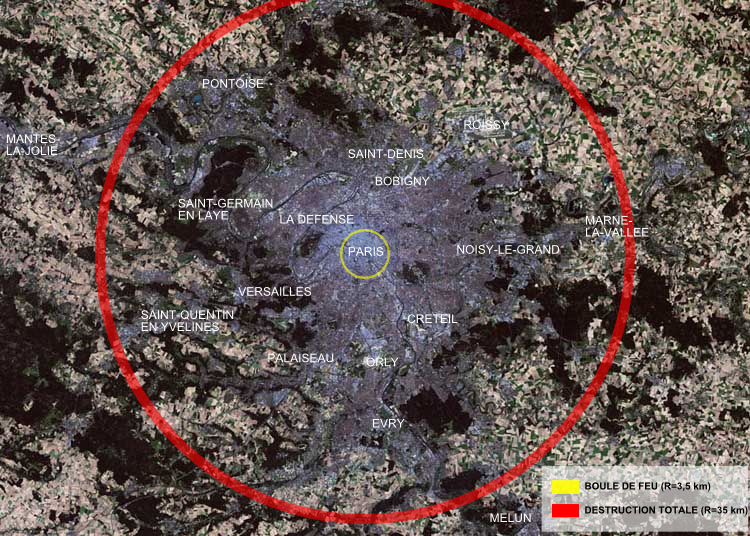
Tsar Bomba test photo and a simulated blast zone overlaid on map of Paris
Wednesday, November 14, 2012
Barrett back on top

Well, it has happened again. The record for longest sniper kill has been broken. Two unnamed snipers from the Australian Army have made what is apparently the successful longest rifle shot in the history of warfare. The snipers both used Barrett M82A1 .50 caliber rifles. The snipers fired simultaneously at a Taliban commander, hitting and killing him. It is not known which of the snipers fired the successful shot. This will likely remain an unofficial record for longest shot in warfare as it is unknown who fired the shot or for that matter, who the snipers were. The implication being that they were both members of Australia's Special Forces, probably 2 Commando Regiment, and will likely not be identified. The distance as measured by GPS was 3079 yards or 2815 meters. At this distance the flight time of the bullet is estimated at 6 seconds. At distances like this, great skill is of course needed, but luck certainly is a major factor. It would be next to impossible to measure the crosswinds, anticipate the targets position after the shot is fired and a dozen other factors that are important for super long range shooting. The previous record for longest sniper kill shot was held by Corporal Craig Ferguson of the British Army. His shot(s) were taken at a distance of 2707 yd or 2475 m with a .338 Lapua fired from a L115A3 rifle.
I am sure that they are pleased with this at Barrett Firearms Mfg, Inc. The last three records were made using their competitor's rifles. Congratulations to the Australians, I hope they will all come home safe and soon.
 |
| Completely unrelated picture of a American sniper with a Barrett M82A1 in Iraq |
Wednesday, November 7, 2012
More Improvised Firearms


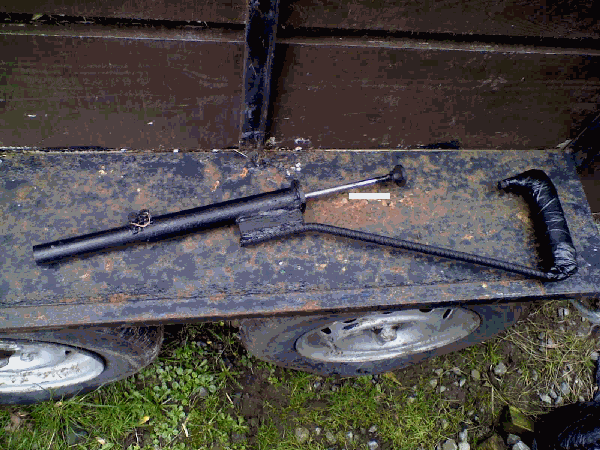
.22 LR lipstick gun. Not very useful, but cool in that James Bond kind of way.


The muzzle brake closely resembles the one from the Tabuk sniper rifle. It seems to have a commercial rail system tactical light and what is likely a inexpensive Chinese scope. I can't tell if any of the other parts come from a real gun or not. My question is, in a country awash with AKs, why risk your fingers and nose with this thing?

T13 "Beano" Impact grenade

During WWII, all sides tried to come up with new military products for use in the war. Some were real breakthroughs and others, well not so much. And that brings us to the T13 "Beano" Impact grenade. Standard fragmentation grenades are used by pulling out the pin which holds the "spoon" or "paddle" on. When the pin is pulled, spring pressure throws the paddle off the grenade and ignites a fuse that burns for approximately 3 to 5 seconds and then detonates the primary explosive. The Beano worked differently. Instead of a timed burning fuse, it used a pressure trigger and an in-flight arming mechanism. To throw the grenade, the user would grip it like a baseball, that is with the first and middle finger together over the top of the grenade and its knurled "butterfly cap". Then the pin was pulled and the grenade thrown. The butterfly cap would come off when the grenade was thrown and then a nylon cord attached to it would play out until it pulled a second arming pin from the interior of the grenade. This armed the grenade to explode when it impacted a hard surface.
Obviously, this raises some important questions. What if you threw the grenade and it landed in soft dirt or mud or water? You have a highly dangerous piece of UXO is what. How much pressure is needed to pull the secondary arming pin? Would it fail to work or be pulled accidentally? How sensitive is the impact fuse? Could you tangle the cord and butterfly cap in gear or barbed wire and cause the grenade (now armed) to come back at you like a tetherball?

The T13 grenade was developed by the OSS, the forerunner of the CIA and manufactured by the Eastman Kodak company. The idea behind its shape was that American soldiers were almost all familiar with throwing baseballs and that they would be able to throw a baseball-shaped grenade further, more accurately and with greater ease than the oblong shape of earlier grenades like the Mk2 "pineapple" grenade or the Mills bomb. Despite accidents and deaths during the testing process, the T13 was approved for field use and some 10,000 were sent to the field for use during the Normandy invasion. It was apparently withdrawn due to a high incidence of accidents and injuries from misuse or poor design. Most existing examples were destroyed and the plans classified. There was a similar design from Italy called the SRCM 35/38 or the "Little Red Devil". It was used during the same time period and there are many documented cases of the grenades being found in an armed, but undetonated state, sometimes killing those who further disturbed them.

Thursday, October 25, 2012
Museum of Naval Aviation, Part 2
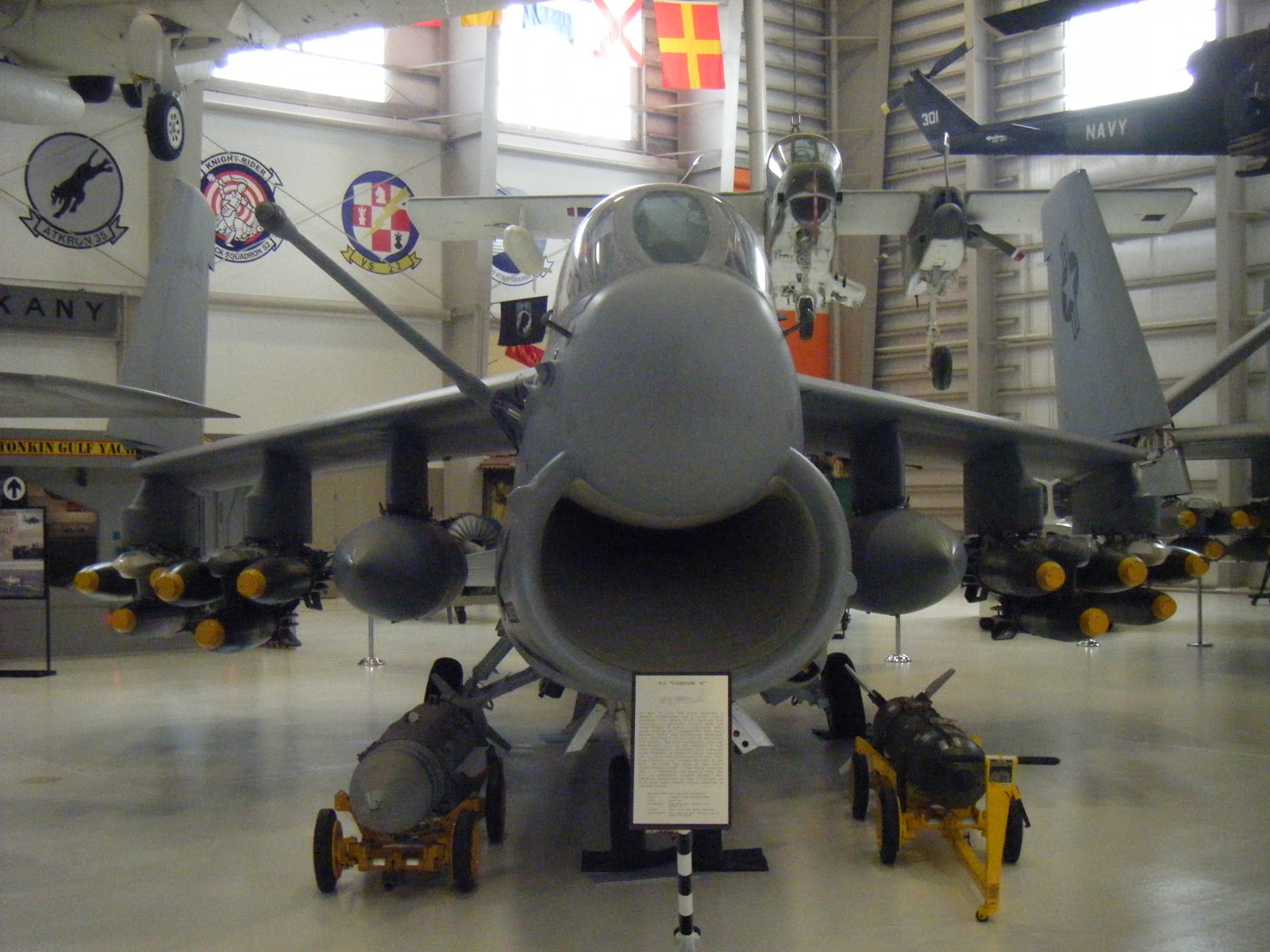
First off today we have the A-7 Corsair II. Built by Vought, the aircraft started with their successful F-8 Crusader design. The design was modified by (amongst other things) shortening the fuselage and deleting the ability to vary the incidence of the wings. The wings of the Corsair II are also longer and less swept back. The A-7 was designed to replace the A-4 Skyhawk in the carrier launched attack role and the aging A-1 Skyraider as well. It was the first US aircraft to feature a Heads Up Display system and also featured a Projected Map Display system (PMDS) that constantly showed the aircraft's position in two different scales. The Corsair II also had a bombing computer that was integrated to its onboard radar that allowed it to make bombing runs at a greater stand off distance and with increased accuracy. The USAF and ANG also flew a version called the A-7D which featured a license built version of the Rolls Royce Spey jet engine and and M61 20mm Vulcan Cannon. The Navy liked so much that they then made their own carrier capable version designated the A-7E. The Corsair II saw its last combat deployment with the US Navy during Operation Desert Storm and it was retired in May of 1991. They were replaced in the US Navy by the F/A-18 Hornet.


The A-1 Skyraider is one the most respected aircraft that the US military has ever flown. It was flown by the US Navy, USMC, and the US Air Force. It also in service with the Royal Navy. It saw extensive combat use with the French Armee de l'Air in Algeria and has fought in many of the post colonial wars in Africa. Designed for WWII, it was used by the US in the Korean and Vietnam Wars, were its ability to provide heavy air support with bombs and strafing runs with its four 20mm cannon made it very popular with ground forces. Many of the features of the Skyraider made their way into its replacement in the Air Force, the A-10 Thunderbolt II. Slow speed maneuverability through a long straight wing. Heavy cannon firepower to destroy armored enemy ground assets. Long loiter time to provide support as needed. (the A-1 could stay in the air for up to 10 hours) It was provided with heavy armor on critical areas, making it much more likely to survive hits from ground fire than the fighter bombers of its day like the F4U Corsair or the P-51 Mustang. It had an amazing 15 external hardpoints for up to 8,000 pounds (3,600 kg) of rockets, bombs, gun pods, mines or anything else that can cause hurt feelings. It was a radial piston engine driven aircraft in the jet age, lasting longer than anyone ever thought it might. For my money, the Skyraider could beat out the stupid Super Tucano any day for a modern COIN aircraft.


Not all the aircraft in the museum belonged to the US Navy. Of special note was the Messerschmidt Me 262, the world's first operational jet fighter. Feared in the sky for their heavy armament of four 30mm cannons and amazing speed of up to 550 mph /900 kph. These were a treasure when captured by Allied ground forces in Germany. They were tested extensively after the war and the technology were used to advance the jets of both the Navy and Air Force. Only about 1400 were ever made and only a few dozen are known survivors today.


Not an aircraft and and not a friend of them either. The Bofors 40mm Anti Aircraft gun in a double mount. This was the primary AA gun of the US Navy in WWII and the variants of the 40mm Bofors cannon are still in service today. The US versions were built by Chrysler and heavily modified from the original Swedish guns. Water cooling for extended firing burst was added and the manufacturing process itself was vastly simplified and cut down. The Bofors 40mm was responsible for thousands of enemy aircraft shot down. The Navy was reportedly so pleased with the weapon that they would telegraph the serial numbers of weapons that shot down enemy aircraft back to Chrysler. This is simply one of the best weapons ever made in the modern era. Several times, in the military forces of several different nations, people have attempted to replace it with something more flashy, more tech-y and more expensive. Then they had to look stupid when the Bofors came back like the cat in the hat.


NAS Pensacola is the training home of the Blue Angels, which are of course the United States Navy's flight demonstration team. In the atrium, the museum displays four Blue Angel A-4F Skyhawks in diamond formation. The Skyhawk was flown by the Blue Angels starting in 1974, replacing the F-4J Phantom II and was replaced by the F/A-18 Hornet in 1986.
 |
| A-7 with A-6 Intruder (right) and OV-10 Bronco and UH-1 Iroquois (above) |


The A-1 Skyraider is one the most respected aircraft that the US military has ever flown. It was flown by the US Navy, USMC, and the US Air Force. It also in service with the Royal Navy. It saw extensive combat use with the French Armee de l'Air in Algeria and has fought in many of the post colonial wars in Africa. Designed for WWII, it was used by the US in the Korean and Vietnam Wars, were its ability to provide heavy air support with bombs and strafing runs with its four 20mm cannon made it very popular with ground forces. Many of the features of the Skyraider made their way into its replacement in the Air Force, the A-10 Thunderbolt II. Slow speed maneuverability through a long straight wing. Heavy cannon firepower to destroy armored enemy ground assets. Long loiter time to provide support as needed. (the A-1 could stay in the air for up to 10 hours) It was provided with heavy armor on critical areas, making it much more likely to survive hits from ground fire than the fighter bombers of its day like the F4U Corsair or the P-51 Mustang. It had an amazing 15 external hardpoints for up to 8,000 pounds (3,600 kg) of rockets, bombs, gun pods, mines or anything else that can cause hurt feelings. It was a radial piston engine driven aircraft in the jet age, lasting longer than anyone ever thought it might. For my money, the Skyraider could beat out the stupid Super Tucano any day for a modern COIN aircraft.


Not all the aircraft in the museum belonged to the US Navy. Of special note was the Messerschmidt Me 262, the world's first operational jet fighter. Feared in the sky for their heavy armament of four 30mm cannons and amazing speed of up to 550 mph /900 kph. These were a treasure when captured by Allied ground forces in Germany. They were tested extensively after the war and the technology were used to advance the jets of both the Navy and Air Force. Only about 1400 were ever made and only a few dozen are known survivors today.


Not an aircraft and and not a friend of them either. The Bofors 40mm Anti Aircraft gun in a double mount. This was the primary AA gun of the US Navy in WWII and the variants of the 40mm Bofors cannon are still in service today. The US versions were built by Chrysler and heavily modified from the original Swedish guns. Water cooling for extended firing burst was added and the manufacturing process itself was vastly simplified and cut down. The Bofors 40mm was responsible for thousands of enemy aircraft shot down. The Navy was reportedly so pleased with the weapon that they would telegraph the serial numbers of weapons that shot down enemy aircraft back to Chrysler. This is simply one of the best weapons ever made in the modern era. Several times, in the military forces of several different nations, people have attempted to replace it with something more flashy, more tech-y and more expensive. Then they had to look stupid when the Bofors came back like the cat in the hat.


NAS Pensacola is the training home of the Blue Angels, which are of course the United States Navy's flight demonstration team. In the atrium, the museum displays four Blue Angel A-4F Skyhawks in diamond formation. The Skyhawk was flown by the Blue Angels starting in 1974, replacing the F-4J Phantom II and was replaced by the F/A-18 Hornet in 1986.
Tuesday, October 16, 2012
Guns I wish I had: MAS 36


Today's wish list gun is the MAS Modele 36. It was the principle French long arm in WWII, adopted in 1936 to replace the older Berthier and Lebel rifles. It is a bolt action rifle, firing the 7.5x54mm French cartridge from an internal 5-round box magazine. It was a mix of conventional, battle proven technology with some French flair. It weighed in at just over 8 pounds and mounts a 22.6 inch barrel. It was built by Manufacture d'armes de Saint-Etienne (MAS) and designed to address shortcomings of the French service rifles used in WWI. It was much shorter and lighter than rifles of the earlier generation and has a reputation as one of the most robust bolt action rifles of the era. And you might think: "Boy, is it ugly". But that is okay, and in my mind, some of the best guns are ugly and some of the prettiest ones don't work all that well. (I call this the Glock/Luger conundrum) In fact, I rather like its non-conformist looks.

 This was done to move the handle closer to the firing hand and make cycling the action faster and smoother. By its reputation, it succeeded. Having not yet had a chance to even handle a MAS 36, I cannot tell you whether or not that is the case. Some internet commenters claim that the action can be cycled without taking one's eyes of the sight, but I have my doubts. But it certainly looks like a more ergonomic action than many that preceded it and it could be worked with the rifle still mounted in the shoulder, which speeds up firing. The MAS 36 can mount a simple and cheap 17 inch spike bayonet that fits into a socket underneath the barrel as you can see below. It is locked in and released by pressing the spring loaded plunger. This is real improvement on the sword-bayonets of earlier eras, which were huge, ungainly, much more expensive to make, and spent 99% of their time hanging uselessly on the belt, getting in the way of sitting down.
As the weapon was intended for France's large conscript army, it was not meant to be serviced in the field, but rather almost all work on the rifle beyond simple cleaning was done by armorers. To this end the barrel bands are secured by nonstandard screws to keep the soldiers from taking the weapon apart. The sights are a mix of good and bad features. Gone were the WWI and earlier sights that dream that regular infantry are going to engage enemy targets beyond 1000 yards. Replacing them was a system that got it right, then got it really wrong. The MAS 36 has a front post sight with nice strong ears to protect it. Good. The rear sight however, makes me despair. (and is the reason I will not be actively searching for a MAS 36 for my own) The rear sight is adjusted in a way I have never come across. Instead of a peep aperture that can be moved right and left or up and down on a screw, it uses different leaf sight plates with the hole drilled a little to the left or right.(or up and down) If your rifle is not shooting on target, the armorer replaces your rear sight with another until it is on target. Each one has a stamped code that denotes whether it is centered or offset. There were 8 different plates for the pre-WWII rifles and 24 (!) for the post-WWII models. This might have worked to make a pretty good sight that is impact and weather resistant, but I just do not like the idea of not being able to adjust the sights quickly and easily. I suppose part of the idea of this strange rear sight is that they did not want the soldiers attempting to zero the sights and getting it wrong.


The MAS-36 does not feature any type of safety mechanism, and the theory behind that is that the soldiers would carry the weapon with a loaded magazine and empty chamber unless (or until) they were in active combat. French troops were taught to fire at the command of their officer- firing as a group, rather than firing "at will". There was also some institutional distrust of safeties in general, with the prevailing opinion being that in the heat of battle, in the wet and mud, a safety might be too difficult to use or that it might get stuck in the "safe" position. While we might think that a rifle without a safety would be obviously less safe, when we look at the training of the French Army, we can see that it might have helped to reduce negligent discharges. The French troops were taught to cycle the bolt twice and visually inspect the chamber upon cease fire to ensure that there were no rounds in the chamber. Discipline was very strict on this matter, as it should be.
 |
| MAS 36 with "cup" hand grenade launcher |
The MAS 36 was used by French forces in WWII, although it was not made in sufficient numbers to be issued to all troops and the Lebel and Berthier service rifles were in use as well. It was used by the Nazis as the Gewehr 242(f), mainly by troops occupying France and by the Volkssturm. Post WWII, it continued to be used, especially in the French colonies, even after it was officially replaced by the semi-automatic MAS-49. There are still descendants of the MAS 36 in service today. The French military's FR F1 and FR F2 marksman's rifles use the same bolt design as the MAS 36 and resemble it a little too.
 |
| MAS 36/51 with 22mm NATO standard rifle grenade launcher |
Several different versions of the MAS 36 have been manufactured. The standard version, a version called the LG48 for firing rifle grenades with a 48mm launcher, the improved MAS 36/51 - strengthened to fire NATO-type rifle grenades,and also a shorter version with a hollow aluminum stock called the MAS 36 CR39 that was designed for paratroopers. The last variant was called the Fusil modele FR-G2 and was equipped with a telescopic sight and a match grade barrel with a harmonic compensator. It was used as a designated marksman's rifle at the time of the Suez Crisis. Some MAS 36 rifles were imported to the USA and rechambered to 7.62mm NATO, but there are a whole bunch of bad reports about them, so I would steer clear unless you just want one to hang on the wall.
 |
| MAS 36 and MAS 36 CR39 paratrooper rifle |
|


Subscribe to:
Posts (Atom)