Showing posts with label Small Arms. Show all posts

Sunday, March 14, 2010

Guns of the Cartels


As the Drug War in Mexico has intensified, there have been many "experts" who blame the violence on the availability of firearms in the United States. While it is certain that the violent drug cartels are smuggling guns south of the border, I for one, do not believe that legitimate gun dealers in the United States are the primary source of guns for the cartels.
To back up this claim, I would like to show you a great many of the weapons seized from the Narcotrafficos in the last few months and years. You will see that they come from all over the world. My personal belief is that the incredibly corrupt Mexican Law Enforcement and Army are the main sources of their weaponry. While semi-automatic rifles and pistols are available in the US, grenades, rockets and machine guns certainly are not. Another thing worth mentioning is that organizations that smuggle hundreds of tons of cocaine a year can smuggle guns just as easily.

Swastika-marked Walther P38s. Not from America.


I always pick up a couple of grenades, an anti-tank rocket or two and a silenced submachine gun at Wal-Mart.
Don't you?
I'm don't know where these grenades were manufactured but I am almost certain they are not an American design.


This gold plated 1911A1 is chambered in .38 Super, a very unpopular cartridge in the US, but popular in Latin America, where many countries have laws against owning a weapon chambered in a "military" cartridge.
(Usually the 9mm NATO or .45 ACP)


Gold plated, short barreled AK? Available at every gun store in Texas.
(sarcasm)


.38 Special, 1911, and a sawed off shotgun. Didn't save its owner however.

This guy didn't make it either
The weapon is a Beretta 92FS, manufactured in several places around the world.


German MG42 with anti aircraft sights.


Another 1911A1 in .38 Super. The Jesus grips are a nice touch, but I bet they would hurt when you shoot it.


AKs and FN PS90s. The FNs are likely from the US though. They are well liked by the Narcos for their ability to pierce soft body armor. They are known as "Matapolicias" (Cop Killers)
Also there is a 40mm grenade launcher and several grenades. Not the type of thing you can legally buy anywhere.


Commando 10" M16 with a drum magazine


.50 caliber rifle mounted in the back of an SUV

More M4s, including a 7.5" barreled version

So there you go. Like I said before, there is no doubt that there are many firearms being used by the cartels that came from the US, but blaming the gun laws of the United States for the actions of bloodthirsty people with no morals and a vast, global criminal empire is, in my opinion, asinine.

Sunday, January 17, 2010

Weird guns- Palm Pistol

This is the the Palm Pistol, from Constitution Arms in New Jersey, an interesting take on a very concealable, last ditch weapon. It is a single shot, breech-loading pistol.It is chambered in the popular and soft-shooting .38 Special cartridge which is widely available and cheap. (well, used to be) Other than its extremely unconventional layout, the main design difference between the Palm Pistol and just about every other gun is that you fire the weapon with your thumb rather than your index finger. The idea is that doing so will reduce muzzle drift, which is one of the main causes of missed shots. Also the lack of a recoiling slide and due to its extremely low bore axis, most of the recoil will be directed straight back along the line of the firer's arm, which may make it easy and comfortable to shoot.


There was some notice of it in the mainstream media (where I saw it) because the inventor claimed that this weapon would be much more suitable for people with physical disabilities and as such, should be paid for by disability and insurance. Needless to say, I don't think any
companies will be buying pistols for seniors and the disabled. The pistol will be marketed with an eye towards people with dexterity limitations or other difficulties that prevent them from operating a traditional pistol effectively. Some of the literature about the weapon also hints at its use as a backup gun and as a covert weapon, but for now I have some doubts.
If it were me, I would add a little muzzle brake/flash hider to decrease the possibility of shooting my own fingers off, or even just burning them on a hot barrel. I suppose it isn't really meant to be shot that much though.

Of course, this is not the first time a pistol shaped like this has been manufactured.

Le Protector, a .32 caliber center fire pistol made in Paris, 1882.

Sunday, December 20, 2009

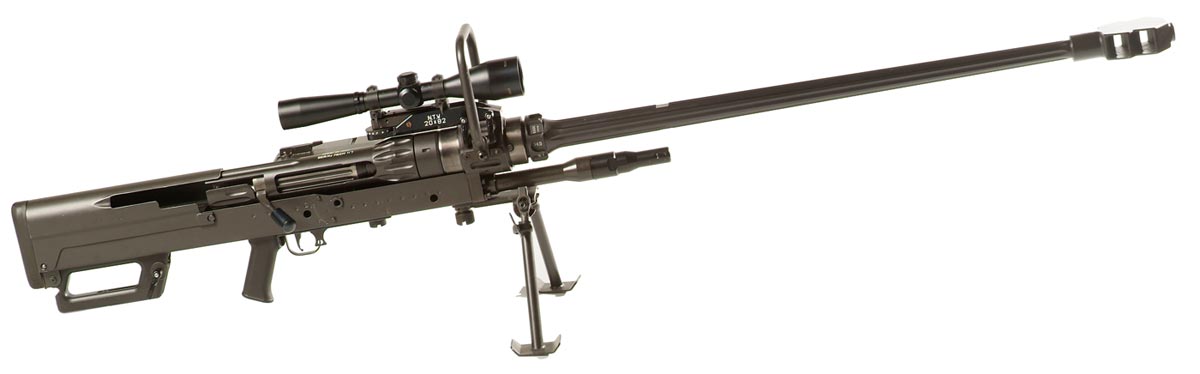
Denel NTW-20 20mm Rifle


Here we have the Denel NTW -20 from South Africa. This is an anti-material weapon mostly designed to destroy important military equipment like radars, aircraft, supply points, and vehicles. This rifle can be configured to fire the Semi-Armour Piercing High Explosive Incendiary (SAPHEI) 20×82mm rounds or the 14.5×114 mm Armour Piercing Incendiary (API). While the 20mm could be used as a "sniper rifle" against enemy personnel, it isn't really made for that. The 14.5mm is much better, with less recoil, increased range and decreased noise, but there are much more effective systems to use. The idea is that a small team of soldiers could cause much havoc behind enemy lines by destroying the equipment needed to fight a war.

Output

One problem with this idea is that firing a gigantic gun like this is sure to draw some attention, primarily of the negative variety. While it has a range of at least 1500 meters, so do most mortars, which is what I would be firing in the direction of the massive report of this monster. So while it is a great weapon, the long term survivability of a team shooting it could be called into question. The weapon itself is absolutely huge, almost 6 and a half feet long and weighing 57 pounds without ammunition. It does break down into two backpacks, but in the real world those soldiers would also be carrying personal weapons, comm gear, armor, water, and food. So mobility is a bit of a problem.


Here is a video from Denel, it shows some of the amazing power this weapon can bring to bear. I don't know who came up with that lame, annoying music though.

Why you should buy a decent gun


This a Lorcin .380 ACP. Notice that the slide has completely split in half. The pistol was reportedly under 200 rounds. Now it is true that any pistol can have catastrophic malfunction, and I've seen plenty of pictures of Glocks and Springfield XDs that have gone ka-boom. But when you think that a gun is a machine designed to harness a small explosion.
And do it a lot. So it really is best to buy a gun you feel that you can trust your life to. It is a lot better to save up another 150 to 250 and buy a mid level used gun like a Ruger, Glock, or even though I don't care for them, a Smith & Wesson.

Wednesday, December 16, 2009

Camoflaged Weapons

Well the poll time has ended and I left it up for more than a month without realizing that I misspelled "modern". Oh well. I don't get paid for this, you know.

64% think that camouflaging a weapon should be the personal choice of its user and 11% think that firearms shouldn't be camouflaged at all. The other 23% are with me and think that modern small arms should all wear some camo. My reasoning is that if you are going to wear camouflage it is silly to have your weapon stick out. Don't believe that? Check these out.

Look at how much more the weapon stands out from the background.
Another thing to consider is that many elite units like the Army Special Forces, SEAL teams and SAS often do camouflage their weapons. And if they do it, everyone should right? ; ) Also, modern "paints" like Duracoat are very good at protecting a weapon from scratches and the elements. Surface rust can begin to form in a day or two on unprotected surfaces. God knows what happens when soldiers get salt water on a gun. I shudder to think.
Nightvision can also make blued and parkerized weapons shine like they are glowing.
Proof you say?
The weapon on the the top is painted, I believe with bowflage, and the lower is a plain AR-15. Notice that the parkered aluminum is very visible. Modern weapons have significant amounts of plastic, and it does not take any more money or time to make them in colors that blend well like olive drab and coyote brown. For those of us who are not paid to be shot at, this is not as vital an issue to be sure. And some people just don't like the aesthetics of camouflaged guns. To each his own. And I've seen some pretty awful paint jobs. But I dare you to look at these and say that they look bad or wouldn't be an improvement over the old standard.

Or you could go this route.

Wednesday, December 9, 2009

Rare Weapons - Stoner 63


The Stoner 63 was designed by the one of the most loved (by some) of all firearms designers, Eugene Stoner, who is most famous for bringing us the AR-15 series of weapons. The Stoner 63 was one of the first weapons to be designed with modularity in mind. From the outset, it was intended as a weapon that would fill the roles of a rifle, carbine, automatic rifle, and light machine gun.
The original prototype was called the M69W, because the receiver is actually turned upside down in the AR and LMG configurations and M69W reads the same upside down. Clever.

The Stoner 63 was ultimately made in 8 different versions although it was often produced as a system with all the barrels, stocks, pistol grip/trigger groups and everything else in the photo above.The main idea was for the weapon's receiver to be invertible to allow it different modes of feeding. As a rifle or carbine, it was fed from the bottom mounted, 30 round, detachable box magazine. In Automatic rifle or Bren gun configuration, it fed from the same type of mag, top mounted. Then the machine gun variant was used its own proprietary disintegrating metal links. Drums and plastic boxes were used, with a 100 to 200 round capacity. Unlike the AR-15, the 63 is operated by a gas piston, which increases weight and felt recoil, but makes the weapon operate cleaner, cooler, and somewhat more reliably.


Automatic Rifle "Bren gun" configuration


If you are not familiar with military small arms you might be thinking to yourself, why the hell is the magazine coming out of the top of the gun? To answer that we go back to WWII. The best of the magazine fed light machine guns or automatic rifles was a Czech design used by the British and Commonwealth forces known as the Bren gun. There are several advantages to the top down magazine system. Namely, you can mount a larger magazine and still go prone. Also the magazine gains some reliability by feeding with gravity instead of working against it. Usually the sights are offset to the right so you can see them clearly.


Stoner LMG with right side feed and short fluted barrel

The belt fed version is the most interesting in my opinion, it is one of the first belt-fed, intermediate caliber light machine guns ever made. For light infantry or special operations troops, this was an important step. In 1963, the M1919 Browning and BAR were still in use.
Not even hard asses can carry either one of those very far without wishing it were lighter. And while the 5.56mm gives up some power and range, you can carry about three times as much. For small units, operating far from resupply, this could be vital. If you look at photos of the Navy SEALs from Vietnam, some times you will see a group and they are all carrying multiple belts of 5.56mm, so that they can achieve high volumes of fire to offset being a small group. Unlike earlier weapons used by US forces, the 63 had a quick change barrel. A machine gun's barrel can be made completely useless if it is fired too fast, for too long. The amount of firing necessary to accomplish this is probably less than you would think.


Rifle configuration, note the gas tube is now above the barrel


The Stoner 63A in the hands of a US Navy SEAL in Vietnam


While the Stoner 63 was evaluated and used by the Marines, SEALs, and US Army Special Forces in Vietnam, no large scale orders were made for it and it has largely faded into obscurity. About 4,000 were made, and some reportedly stayed in service until being replaced by the M249 SAW in the mid 1980's. Today probably less than 50 are in existence. The carbine and rifle versions were fairly heavy because they had the reinforced receiver needed for the LMG version. The design was fairly complex, and is said to need a good deal of maintenance to stay reliable in the Southeast Asian jungles. it ended up that, as a carbine or rifle, it was heavier than the M16, and it was not as powerful as the 7.62mm M60 machine gun. All that being said, it was a revolutionary design, in my opinion at least as good as the AR-15. (Keep in mind the AR-15 has been upgraded and tweaked for many years now.)

Today, Robinson Arms Company makes a similar (looking) weapon, a semi auto rifle, carbine, or Bren type called the M96. However, they are more than $1500.00, so I won't be getting one.
(unless one of you nice folks wants to make a contribution)


The Stoner 63 Family

Tuesday, December 8, 2009

Boberg XR-9

Anyone who has carried a pistol can attest that it is really much easier to wear a pistol if it is fairly small and light. All sorts of ways to decrease a pistol's overall size have been tried throughout the years but this is a new one.

The concept of the XR-9 pistol is to provide the ballistics (penetration and terminal effects) of the full-size pistol in sub-compact pistol, suitable for concealed carry. The XR-9 was initially designed in 2004 and is in its third prototype as of now. Boberg Engineering developed a method of lengthening the barrel by changing the feed mechanism. Unlike most semi auto pistols, the XR-9's design extends the barrel further back into the slide and places its breech area and chamber above the magazine, instead of being located in front of the magazine.

Look at the photo below and note the feed claws that grip the topmost cartridge in the magazine. In autoloading, the claws pull it back and up for loading into the breach. Boberg used a "push- pull" system similar to the one that was used on the Gabbet-Fairfax Mars pistols of the early 20th Century. A related system is used in some older type belt fed machine guns such as the Maxim, Browning and PK. Boberg claims the XR-9 can provide an increase of muzzle energy of about 25% compared to pocket pistols of the same size and caliber.

Look at the feed claws gripping the cartridge before pulling it back and up for loading into the breech


The Boberg XR-9's trigger is double action only (DAO) and it is hammer-fired. The action is short recoil operated. The two-stage "pull-push" feed system centers around the claw-shaped loader, which to the slide on a pivot. When the slide is cycled the the claw pulls the cartridge rearwards from the magazine and at the end of recoil stroke, claws are lifted to place the cartridge to feed position. On the closing stroke of the slide, cartridge is pushed into the barrel chamber, and the feed claws are lowered to grip on the following round in the magazine.


The XR-9's barrel is about 1.2inches longer than the Kahr PM9, with an approximately even overall length