Showing posts with label nuclear weapons. Show all posts

Thursday, January 17, 2013

Missile Silo Blast Door art

This art adorns the blast doors of a Delta One Launch Control Facility for Minuteman II Intercontinental Ballistic Missiles in South Dakota. With its ICBMs deactivated and destroyed per the 1991 START treaty, the Launch Control Facility and its missile silo are  now a historical site run by the National Park Service.
Grim but cheeky  I like it. 

Monday, November 19, 2012

Nuclear scale


 Castle Bravo Test


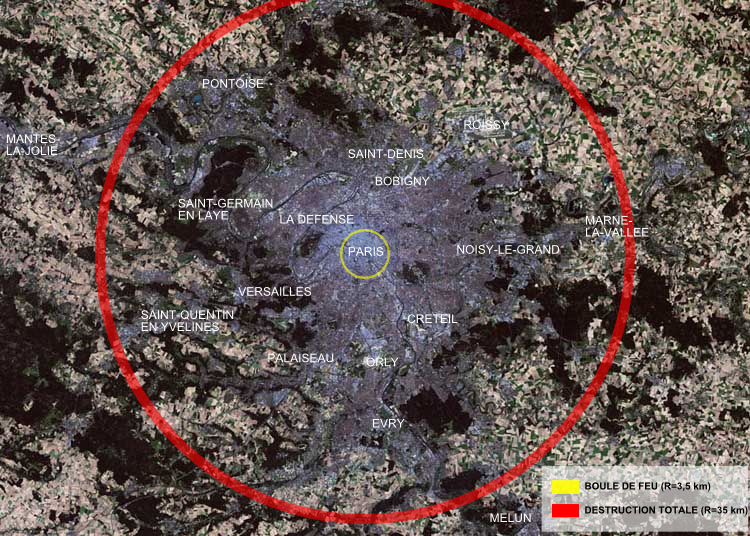
Tsar Bomba test photo and a simulated blast zone overlaid on map of Paris

Tuesday, May 18, 2010

Typhoon-class Submarine


Today's subject is the Typhoon-class Nuclear Ballistic Missile Submarine. The Typhoon was known in Soviet service as the Akula, which is Russian for a shark. We called it the Typhoon because we (being NATO) had a thing for renaming every single bit of Soviet or Warsaw Pact weapons and equipment. It probably gave a job to an entire office building. But I digress.


With a displacement of 33,000 tons, the Typhoon was the largest submarine to ever enter service. It is just huge. Famously, unlike every other cramped boat that ever went under the waves on purpose, it was gigantic, including adequate (for a submarine) crew spaces. It even had a gym with a pool and sauna. (The pool was really small though) As it is a nuclear ballistic missile submarine, the job of the Typhoons in the event of war is to hide in the polar ice cap until they receive orders to launch their multiple reentry vehicle nuclear missiles. Why hide under the icecap?
The problem is that there are only a few ways for the Soviet Navy to enter the North Atlantic. The Greenland-Iceland United Kingdom gap (GIUK gap)was watched by subs, planes, satellites, and underwater sensors. Because few Soviet submariners would survive fighting in the North Atlantic. The Allied victory against the Wolfpacks in WWII and the cat and mouse of the Cold War taught the Russians that. With many different types of assets guarding the approaches to the North Atlantic, watching Soviet sub bases and shadowing the fleet, the Soviets needed a way to ensure they could strike the USA.


The Typhoon class was one of the best designs to come out of Soviet Russia during the Cold War era. It made significant leaps in being was quieter than previous Soviet missile boats and was well armed. Attention to crew comfort could make a very real translation to a more motivated and sharp crew. At least to a degree. The Typhoon class also features six torpedo tubes, with four of those having the ability to launch the standard Type 53 torpedo or the SS-N-15 (RPK-2) anti ship missiles. The other tubes, which might have been located in the rear (just a guess) could lay mines in addition to using the Type 65 torpedo and the RPK-7 missile.


The Typhoon has multiple pressure hulls to increase survivability. This is part of what gives the subs their massive size. They have a very wide beam, much greater than the U.S. Ohio-class (the black and red sub in the pic below). Like most nuclear powered subs, the Typhoon can stay underwater nearly indefinitely, it is said to be able to stay under at least 180days, and I imagine that could be continued further, right up until they ran out of borscht and potatoes. The primary armament of the Typhoon is 20 R-39 missiles ( SS-N-20 in NATO designation) with up to 10 MIRV nuclear warheads on each. They are using the last of the Typhoons as a test bed for the new SLBM and it was likely a Typhoon that launched the missile that malfunctioned a few months ago.


Of all the Typhoons built (6), only three still exist, with one in service (the Dmitriy Donskoy) and the other two. Arkhangelsk (TK-17) and Severstal (TK-20) are likely currently in an un-seaworthy condition. All the R-39 missiles have been retired. However, with Russia's resurgence, they may one day be refitted to carry cruise missiles and modernized to be a SSGM for future service, or perhaps even sold to another nation. The Typhoons are slated to be replaced by the Borei class starting in 2010-11.

Typhoon Submarine, being guarded by the best of the Russian Navy

Tuesday, February 23, 2010

XB-70 Valkyrie


In my opinion, this is one of the most interesting-looking bombers to ever fly, the XB-70 Valkyrie, designed by North American Aviation. It was intended to be a supersonic, nuclear- armed, deep penetration bomber. It was designed way back when military planners thought that the B-52 would be retired by the late 1960s. (They were way wrong and the common belief is that the last pilot of the B-52 has not yet been born.)

The Valkyrie was designed to fly at or above 70,000 feet and at speeds up to Mach 3 to avoid being targeted by interceptor fight aircraft, the only effective way of defending against high altitude bombers at the time of the XB-70's design. Only two were ever built and the program was canceled in 1961 when it became apparent that the new surface to air missiles made high altitude attack untenable. This was most evident when the U-2 "Dragon Lady" piloted by Francis Gary Powers was shot down over the Soviet Union in 1960 by a volley of SA-2 Guideline missiles. The Valkyrie was later used for high speed and altitude testing, and some of their technology resurfaced in the B-1 Lancer and SR-71 Blackbird.


3 views of the XB-70

The Valkyrie was an advanced design, making use of honeycombed steel and titanium to combat the high temperatures that the airframe reached at supersonic speeds. The XB-70 was built around a large delta wing, common in designs of the time, and used supersonic technologies from the Mach 3 Navajo. One of its most interesting features is the use of compression lift. This created a shock wave below the aircraft that would increase the lift of the wing by 5%, giving the Valkyrie greater ceiling, range, and efficiency. The compression lift was generated by a wedge on the engine inlets. The design of the Valkyrie was different from almost every other aircraft in its time, in that the outer sections of the wing was hinged so that it could be pivoted down up to 65 degrees. The effect was to increase the directional stability of the the XB-70 when it was traveling at supersonic speeds and strengthen the effect of the compression lift. When the wingtips were pointed down, more of the shock wave would be trapped under the wings, increasing the lift.


General characteristics

Data from USAF XB-70 Fact sheet

Performance


Early designs featured wing tip fuel tanks that could be jettisoned with the wing tips


Sadly, one of the XB-70s was lost in a terrible collision between the Valkyrie and a F-104 Starfighter in 1966. The F-104 pilot and the co-pilot of the XB-70 were killed and the pilot of the Valkyrie severely injured by the clamshell escape pod that closed on his left arm as he ejected.

XB-70 Valkyrie seconds after impact with a F-104 Starfighter

Sunday, January 24, 2010

Nuclear Weapons

I came across these pictures of nuclear weapons and their delivery methods. I thought they were very interesting, so I decided to share them with you. Everything shown here is American-made.


B-29 Superfortress

B-36 Peacemaker

B-46 Stratojet

B-52 Stratofortress

B-1B Lancer

B-2 Spirit "Stealth Bomber"


Interior views of Atlas ICBM silos


Atlas Intercontinental Ballistic Missile


Conning tower of an Ohio-Class Ballistic Missile Submarine


"Little Boy"- The Hiroshima Bomb - 13-18 kiloton yield


"Fat Man" Nagasaki Bomb - 22 kiloton yield


Mk 6 Fission Bomb - variable yield 8, 26, 80, 154, or 160 kilotons


"Physics Packages" of implosion-type Fission Bombs

Monday, December 14, 2009

Vela Incident

On September 22, 1979, the United States surveillance satellite Vela Hotel 6911 observed a double flash at 00:23 GMT. The flash was detected at approximately 47 degrees South, 40 degrees East. This area is between The Prince George Islands of South Africa and Bouvet Island, which is owned by Norway, but is very small and totally uninhabited.


In the weeks and months that followed, elevated levels of iodine 131, which is a short half life product nuclear fission, were discovered in the thyroid glands of sheep in Tasmania and Victoria , directly where the prevailing wind patterns would distribute the fallout. However, US Air Force planes searched the area in the days following the flash and were unable to find any traces of radiation. It is noted that the low pressure area that surrounded the suspected test area was not searched by the Air Force.

Some have said that the Vela Incident was the result of a meteorite impact. These impacts, such as the Tungusta Event in Siberia in 1908, do generate explosions that are similar in some ways to a nuclear detonation. They can range from the low kilotons to the multiple megaton level, such as the Tungusta Event. However, they do not produce the distinctive "double flash" of a nuclear weapon.

Others have stated that the satellite was past its functional service life and was fooled by the impact of a micrometeorite and the resulting dust reflected light at the satellite. However, the scientists that worked on the Vela Hotel program and Los Alamos Labs have stated that they believe that the satellite was functioning correctly and reported the flash as it had been designed to do.

Two Vela Hotel Satellites


Simply put, most evidence leads one to believe that the event was a secret nuclear test.
If we are to accept that as true, the next question was who did it? The top suspects are South Africa, Israel, India, and France. All had nuclear weapons programs at the time.
India is usually discounted, because although they are a nuclear nation, and performed a test in 1974, the test location was very far from their territory and the Indian Navy did not have a large presence there at the time. France comes into play because the site was not too far from the French Kergulen Islands and the French had a history of atmospheric tests in the South Pacific.Therefore, some have postulated that the event was a test of a French Neutron Bomb. Israel is the hardest of the four to say yes or no about, because the position of the Israeli Government has always been to neither confirm nor deny their nuclear program and capabilities. The most likely culprit is the Republic of South Africa. The incident took place very close to their territory and they were known to have nuclear program at the time. However, some have said that the South Africans could not have produced a weapon by that time and that all possible nuclear weapons from South Africa have been accounted for.

Several books have been written about the event, and most allege that it was a joint Israeli-South African test, designed to be small enough to escape detection. In 1994, Dieter Gerhardt ,a former South African Naval officer and convicted Soviet spy after his release from prison in South Africa, said:

"Although I was not directly involved in planning or carrying out the operation, I learned unofficially that the flash was produced by an Israeli-South African test, code-named Operation Phoenix. The explosion was clean and was not supposed to be detected. But they were not as smart as they thought, and the weather changed – so the Americans were able to pick it up."

Now for full disclosure: This is all rumor and conjecture and there are a lot of people who state that not only was there no nuclear explosion, there was no event at all, and it was all a result of faulty equipment. But that is no fun.

Tuesday, December 8, 2009

USA and USSR/Russia Nuclear stockpiles


Just in case you were wondering you know. Pretty crazy to think that in 1987 there were more than 60,000 nuclear weapons, ready to be detonated. I believe the numbers have gone down a little since this was made, but probably not much, and the standard conspiracy theory is that both the USA and Russia are developing a new generation of nuclear weapons.

Thursday, October 22, 2009

This Day in History- October 22

Cuban Missile Crisis

On October 22, 1962, President Kennedy announced that Soviet Nuclear Missiles had been discovered in Cuba. These were medium range missile capable of hitting most of the cities on the Eastern seaboard, including Washington. Kennedy stated that he was ordering a naval "quarantine" of Cuba to prevent Soviet ships from transporting any more offensive weapons to the island and explained that the United States would not tolerate the existence of the missile sites currently in place. Kennedy made it clear that America would not stop short of military action to end what he called a "clandestine, reckless, and provocative threat to world peace."

The Cuban Missile Crisis actually began on October 15, 1962--the day that U.S. intelligence personnel analyzing U-2 spy plane data discovered that the Soviets were building medium-range missile sites in Cuba. The next day, President Kennedy secretly convened an emergency meeting of his senior military, political, and diplomatic advisers to discuss the ominous development. The group became known as ExCom, short for Executive Committee. After rejecting a surgical air strike against the missile sites, ExCom decided on a naval quarantine and a demand that the bases be dismantled and missiles removed. At the direction of the Joint Chiefs of Staff, U.S. military forces went to DEFCON 2, the highest military alert ever reached in the postwar era, as military commanders prepared for full-scale war with the Soviet Union.

The next day, however, Khrushchev upped the ante by publicly calling for the dismantling of U.S. missile bases in Turkey under pressure from Soviet military commanders. Later that day, a U-2 spy plane was shot down over Cuba, and its pilot, Major Rudolf Anderson, was killed. Waffling, Kennedy forbid a military retaliation unless any more surveillance planes were fired upon over Cuba. Kennedy's advisers convinces him to agree to dismantle the U.S. missile sites in Turkey but at a later date, in order to prevent the protest of Turkey, a key NATO member.

On October 28, Khrushchev announced that he would dismantle and remove all offensive Soviet weapons in Cuba. With the airing of the public message on Radio Moscow, the USSR confirmed its willingness to proceed with the solution secretly proposed by the Americans the day before. The world stepped back from the brink of nuclear war and what became known as the Cuban Missile Crisis was over. By the end of 1962 all the Nuclear missiles had been removed. Soon after, the United States quietly removed its missiles from Turkey.

The removal of obsolete Jupiter missiles from Turkey had no detrimental effect on U.S. nuclear strategy, but the Cuban Missile Crisis convinced a humiliated USSR to commence a massive nuclear buildup. In the 1970s, the Soviet Union reached nuclear parity with the United States and built intercontinental ballistic missiles capable of striking any city in the United States. However, later review of Soviet technology leads many to believe that the design and manufacturing flaws in Soviet ICBM would result in many being unable to launch, and most unable to hit within 50 miles of their targets.

Military Technology- Atomic Cannon

Here we go. The M65 "Atomic Annie"


The Department of Defense decided that they wanted an atomic capable artillery piece in 1949 and chose a engineer named Robert Schwartz to design it. The Atomic Annie was created by Picatinny Arsenal and was designed by essentially scaling up the largest cannon in the arsenal, the 240mm, and using the German K5 Railroad gun as a basis for its carriage.
First fielded in 1953, eventually 20 of these monsters were manufactured and they were deployed to bases in Germany and Korea to threaten the commie hordes. The gun sites were reportedly moved often to avoid being targeted by enemy forces.


The M65 was rendered obsolete fairly quickly as the DoD soon created nuclear artillery shells that were compatible with standard 155mm and 203mm cannon, and later the invention of heavier rockets, and eventually the ICBM. But since it was so sweet and military planning in that era was very conservative and fully expecting Ivan to sweep into Western Europe with thousands of tanks it remained in service until 1963.


The M65 was transported by two specially designed 375 horsepower tractors, with independent steering like some very long fire engines. The result did not look very graceful, but it could get up to 35mph and make turns on a 28 foot wide road. The Atomic Annie could be unlimbered in 15 minutes and then returned to traveling configuration in 15 minutes more. The name "Atomic Annie" is said to be related to "Anzio Annie" the name of a K5 gun that was used against the US Army landings in Anzio, Italy during WWII.

On May 25, 1953 at 8:30am local time, the Atomic Cannon was tested at the Frenchman Flat of the Nevada Test Site as part of the Upshot-Knothole series of nuclear tests. The test--codenamed Grable-- resulted in the successful detonation of a 15 kt shell (warhead W9) at a range of 7 miles. This was the first and only nuclear shell to be fired from a cannon.

Wednesday, August 26, 2009

One Morning...

Someone woke up and said,
"I feel like blowing up paradise!"

Operation Crossroads, Bikini Atoll, 25 July 1946.
Baker test, 23 Kiloton Bomb, detonated 90 feet underwater

Enlarge this pictures and see that those ships are Battleships, Cruisers, Destroyers, and an Aircraft Carrier. These tests were conducted to further understand the effects of nuclear weapons and radiation on Naval Vessels, harbors, and living creatures.

Bikini Atoll was used for later thermonuclear tests as well, Operation Castle detonating 7 weapons for a total of 75 megatons. The Bravo test of the "shrimp" device was projected to be 6 megatons and was actually 15mT , causing extensive radiological damage to the surrounding area. The intense thermal flash ignited a fire at a distance of 20 nautical miles on the island of Eneu (base island of Bikini Atoll). Then we made a bunch more of those bastards. (The Mk-21 Gravity Bomb, which we made at least 275 of)