Showing posts with label C-130 Hercules. Show all posts

Tuesday, July 17, 2012

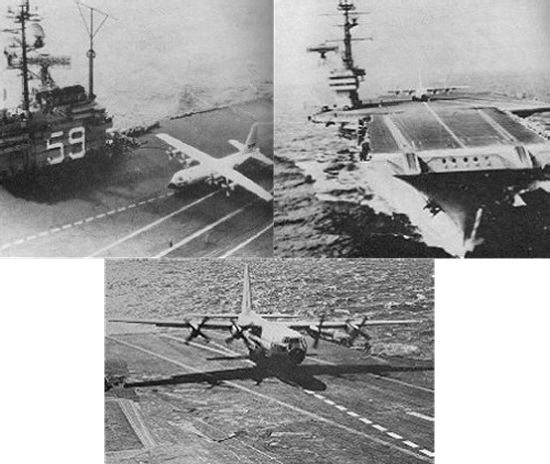
C-130 Aircraft Carrier landing


I would not have thought it possible, be here we see the photo proof that a C-130 can in fact land and take off from an aircraft carrier. This occurred on the USS Forrestal in 1963. It is to this day, the heaviest and largest aircraft landing and takeoff from a carrier. Amazingly, this USMC KC-130F, with a Navy Lieutenant at the helm, landed on the deck without the use of the arrester cables. The C-130 can change the direction of its propeller blades in order to slow the aircraft and land in a much shorter strip. The crew did this just prior to landing to decrease the space needed to stop the aircraft.  Records state that the Hercules made 29 touch and go landings, 21 full stop, unarrested landings and 21 unassisted (no steam catapult) take-offs. Landings and takeoffs were made at several weights from 85,000lbs to 121,00lbs. When at low weight, the Hercules was able to stop in 267 feet, only slightly more than double the wingspan! At the max tested weight, it only required 775 feet for takeoff and 460 feet for landing. This very aircraft was in fact, in service up until 2003 and is now on display at the National Museum of Naval Aviation in Pensacola, Florida. The Navy ultimately decided that the margin for error was too small for operational use and developed the C-2 Greyhound for the COD (Carrier On board Delivery) mission. 


For those that might doubt the veracity of my reporting on this matter, there is a Youtube video of a landing, but embedding was disabled so you will have to go to Youtube all by yourself to see it. 


Oooh look! Color photo of takeoff!

Sunday, March 14, 2010

More Museum of Aviation


To start off, a F4 Phantom. Note that this one has a M61 Vulcan 20mm gun pod mounted under the right wing, as the F4 was the first US fighter to be manufactured without an on board gun.


Here we have one of the weirdest looking planes ever, the F-104 Starfighter. It certainly must have the smallest wings. They are extremely thin and unlike most fighters of its day, not in the swept or delta shape, but rather, a trapezoid. The F-104 was used in Vietnam as a air superiority fighter, but apparently was not very successful or well liked by its pilots.


Here we have a C-130 Hercules, which is pretty much the most useful transport aircraft ever designed. More than 2,262 have been produced and they are in the service of at least 40 or 50 nations. They first flew in 1954 and will likely be a major component of military airlift for at least another 25 or 30 years, perhaps many more. The C-130 is a very rugged aircraft and can land on very short and poorly maintained airstrips if there is a need. There are even versions with skis that they use to fly to scientific bases in Antarctica. It fulfills all sorts of roles, from general cargo airlift to paratrooper transport to electronic warfare (EC-130H Compass Call), to aerial refueling, to transporting light armor like the Marine Corps' LAV III and the Army's Stryker. Crazy folks in the Air Force even fly the C-130 into hurricanes to gather atmospheric data. If you are sitting there thinking he left out the AC-130 Gunship, scroll down.


This is an older version of the gunship, an AC-130A. The Gatling guns, both 7.62mm and 20mm, were removed, likely to be transferred to another aircraft, but the Bofors 40mm guns were still mounted.


This is the big one folks. The B-52 Stratofortress. Oddly enough, it did not seem as big as I had imagined it. But it is still seriously big.


And to end, another F4, this one has two Red Stars for two MiG kills over Vietnam.