Showing posts with label US Navy. Show all posts

Wednesday, October 10, 2012

Medal of Honor: Commander David McCampbell, US Navy

McCAMPBELL, DAVID 

Rank and organization: Commander, U.S. Navy, Air Group 15. 

Place and date: First and second battles of the Philippine Sea, 19 June 1944. 

Entered service at: Florida. Born: 16 January 1910, Bessemer, Ala. 

Other Navy awards: Navy Cross, Silver Star, Legion of Merit, Distinguished Flying Cross with 2 Gold Stars, Air Medal. 

Citation: For conspicuous gallantry and intrepidity at the risk of his life above and beyond the call of duty as commander, Air Group 15, during combat against enemy Japanese aerial forces in the first and second battles of the Philippine Sea. An inspiring leader, fighting boldly in the face of terrific odds, Comdr. McCampbell led his fighter planes against a force of 80 Japanese carrier-based aircraft bearing down on our fleet on 19 June 1944. Striking fiercely in valiant defense of our surface force, he personally destroyed 7 hostile planes during this single engagement in which the outnumbering attack force was utterly routed and virtually annihilated. During a major fleet engagement with the enemy on 24 October, Comdr. McCampbell, assisted by but l plane, intercepted and daringly attacked a formation of 60 hostile land-based craft approaching our forces. Fighting desperately but with superb skill against such overwhelming airpower, he shot down 9 Japanese planes and, completely disorganizing the enemy group, forced the remainder to abandon the attack before a single aircraft could reach the fleet. His great personal valor and indomitable spirit of aggression under extremely perilous combat conditions reflect the highest credit upon Comdr. McCampbell and the U.S. Naval Service. 


Commander McCampbell was also the third highest scoring ace in the Navy in WWII, with 34 aerial victories and the highest scoring ace to survive the war.  He served in active duty until 1964 and the Arleigh Burke-class AEGIS guided missile destroyer, the USS McCampbell (DDG-85) was named in his honor.

Tuesday, July 17, 2012

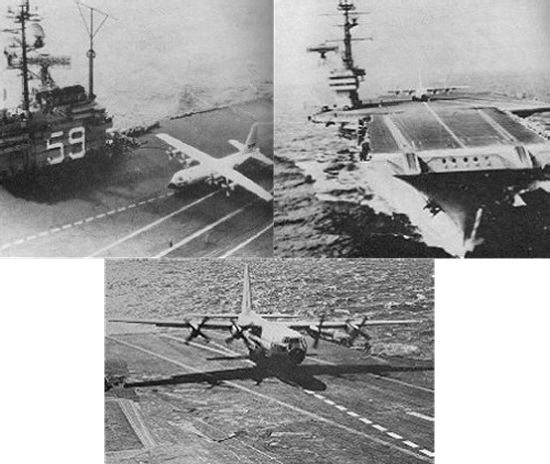
C-130 Aircraft Carrier landing


I would not have thought it possible, be here we see the photo proof that a C-130 can in fact land and take off from an aircraft carrier. This occurred on the USS Forrestal in 1963. It is to this day, the heaviest and largest aircraft landing and takeoff from a carrier. Amazingly, this USMC KC-130F, with a Navy Lieutenant at the helm, landed on the deck without the use of the arrester cables. The C-130 can change the direction of its propeller blades in order to slow the aircraft and land in a much shorter strip. The crew did this just prior to landing to decrease the space needed to stop the aircraft.  Records state that the Hercules made 29 touch and go landings, 21 full stop, unarrested landings and 21 unassisted (no steam catapult) take-offs. Landings and takeoffs were made at several weights from 85,000lbs to 121,00lbs. When at low weight, the Hercules was able to stop in 267 feet, only slightly more than double the wingspan! At the max tested weight, it only required 775 feet for takeoff and 460 feet for landing. This very aircraft was in fact, in service up until 2003 and is now on display at the National Museum of Naval Aviation in Pensacola, Florida. The Navy ultimately decided that the margin for error was too small for operational use and developed the C-2 Greyhound for the COD (Carrier On board Delivery) mission. 


For those that might doubt the veracity of my reporting on this matter, there is a Youtube video of a landing, but embedding was disabled so you will have to go to Youtube all by yourself to see it. 


Oooh look! Color photo of takeoff!

Monday, October 10, 2011

This Day in History - October 10

1845 - United States Naval Academy founded in Annapolis, Maryland

The institution was founded as the Naval School by Secretary of the Navy George Bancroft. The campus was established at the site of a former US Army post called Fort Severn. The school's first class had 50 Midshipmen students and seven professors. later the USS Constitution was refurbished and used as a school ship for the fourth class midshipmen. The plebes were introduced to Navy life and and traditions while they lived on board the ship which usually at anchor.

The decision to establish an academy on land is said to be a result of the infamous Somers Affair, an alleged mutiny involving the son of the Secretary of War that resulted in his execution via hanging at sea.

Wednesday, July 7, 2010

Military Technology- Razzle Dazzle Camouflage


In an effort to better protect ships from attack, especially from the threat of submarines, British artist and Royal Navy Lieutenant Commander Norman Wilkinson devised a camouflage scheme for warships at sea. The idea was to use a pattern of angular, geometric shapes and lines in bold, contrasting colors. The scheme became known variously as Razzle Dazzle, Dazzle camouflage or Dazzle painting. It was used a great deal on the ships of the Royal Navy and others in WWI. It was used as late as the end of WWII on some American Navy ships.


About this time, after viewing the above picture, you may be thinking that artist/camouflage designer Norman Wilkinson perhaps became confused and drank a glass of turpentine while he was working. That might explain trying to conceal a 600 foot long, 11,000 ton ship by painting it in purple star bursts. But the point was never really to hide the ships from view. Rather, the aim was to make ships trying to fire on the ship confused about the direction, speed, size, and range of their target. So the point was really to confuse the rangefinders and gunners of the enemy, not to hide from their lookouts and scouts. The hope was the Dazzle camo would make the enemy unable to identify the ship, or to tell whether they were looking at the bow or stern, or even if it was approaching or sailing away. Rangefinders of the early 20th Century operated on the co-incidence principal. The idea is that the ship is targeted with the rangefinder and the operator sees two half-images of the ship. He adjusts the knobs until the images meet up and finds the range based on tables and such. The camouflage was supposed to hinder this by making a pattern that seemed to not match up correctly at any range. Also, the dazzle patterns usually had a false bow wave to throw off accurate estimation of the ships' speed.

In a 1919 lecture, Norman Wilkinson explained:

The primary object of this scheme was not so much to cause the enemy to miss his shot when actually in firing position, but to mislead him, when the ship was first sighted, as to the correct position to take up. [Dazzle was a] method to produce an effect by paint in such a way that all accepted forms of a ship are broken up by masses of strongly contrasted colour, consequently making it a matter of difficulty for a submarine to decide on the exact course of the vessel to be attacked.... The colours mostly in use were black, white, blue and green.... When making a design for a vessel, vertical lines were largely avoided. Sloping lines, curves and stripes are by far the best and give greater distortion.


RMS Empress of Russia, painted with Dazzle camo as troopship in WWI


The British painted over two thousand ships with Dazzle camo in WWI, much of the work was supervised by artist Edward Wadsworth. The patterns and colors were different for each ship, and each pattern was tested in miniature before being used. The small wooden models were viewed through a periscope and the patterns evaluated by Naval personnel before being scaled up. Most of the models were constructed and painted by women from the London Royal Academy of Arts.


Man, that is just nauseating


Razzle dazzle was evaluated and selected by the US Navy in 1918 and the Navy continued to use it to varying degrees through the end of WWII. All of the Essex-class carriers and Tennessee-class battleships were painted with Razzle Dazzle camouflage. Rather than the unique designs of the Royal Navy, the US Navy decided to standardize the process and paint the various ships with tested and approved designs.

Was Razzle Dazzle effective? Well, your guess is as good as mine. It is very possible that the protection was negligible. Even if if worked well for a little while, it is certainly possible that the Germans could have found technology and tactics to work around it. In post war reports, the British Admiralty decided that it had no effect on the success of submarine attacks. They did however, feel that the bold and brightly colored ships inspired higher morale in both the ship's crews and the public. So I guess that was nice.

Whether or not the idea working in WWI, by the end of WWII it was close to completely obsolete. The amazing jump in effectiveness of naval based reconnaissance planes made many of its features useless, and the technology of visual rangefinders got better as well. With the advent of radar and radar range finders, Dazzle camouflage was done. There are however, some people who stated that it was still effective against submarines, which at the time usually needed to stalk their prey from underwater and their only view of the target was from tiny periscopes just inches off the surface.


HMS Belfast with the camouflaged paint scheme it had during WWII

Sunday, December 20, 2009

Wasp class Amphibious Assault Ship


Above is the USS Wasp, the first of the Wasp-class Amphibious Assault Ships. These ships are designed to land forces on a hostile shore and support them. They are the largest such ships in the world and in many ways, are more powerful than the aircraft carriers of other nations and aircraft carriers from the past. The Wasp-class has the ability to launch surface craft from its rear well deck and can also launch helicopters and AV-8B Harrier II STOL aircraft from its flight deck. Sometimes the LHD will carry as many as 20 Harriers when it is configured as a "Harrier Carrier" with a narrower focus on close air support of ground forces.
The LHD launches LCACs (Landing Craft, Air-Cushioned - hovercraft) and LCUs (Landing Craft Utility) to ferry Marines and supplies to the store. They can also launch the AAVs (Amphibious Assault Vehicles). To further support operations on shore, every Wasp-class warship has a hospital with 600 patient beds and six operating rooms.


USS Wasp embarking a LCAC

The Wasp-class is descended from the earlier Tarawa-class. The main differences are that the Wasp is longer to fit the LCAC and does not have the 5 inch guns of the Tarawa-class. These ships are named after famous battles of the United States Marine Corps or for WWII aircraft carriers. The entire Wasp-class of eight ships was built at the Ingalls Shipbuilding Co. in Pascagoula, Mississippi, the USS Wasp being commissioned on July 30, 1989.

Landing Craft Utility in the well deck of the USS Essex


General characteristics
Class and type: amphibious assault ship
Displacement: Approx. 40,500 tons (41,150 metric tons) full load
Length: 844 ft (257 m)
Beam: 106 ft (32 m)
Propulsion: Two boilers, two geared steam turbines, two shafts, 70,000 shaft-horsepower (52 megawatt);
but two General Electric LM2500 geared gas turbines, two shafts on the USS Makin Island)
Speed: 20 knots (37 km/h)

Complement: 104 officers, 1,004 enlisted
1,894 Marine Detachment

Armament: Two Rolling Airframe Missile launchers
Two Sea Sparrow missile launchers
Three 20 mm Phalanx CIWS systems (LHD 5-7 with two)
Four .50 BMG machine guns
Four 25 mmMk 38 chain guns (LHD 5-7 with three).
Aircraft carried: Actual mix depends upon the mission[1]

Standard Complement

6 AV-8B Harrier II attack aircraft
4 AH-1W SuperCobra attack helicopter
12 CH-46 Sea Knight helicopters
4 CH-53 Sea Stallion helicopters
3 UH-1N Huey helicopters
OR
Assault
42 CH-46 Sea Knight helicopters
OR
Sea Control
20 AV-8B Harrier II attack aircraft
6 SH-60F/HH-60H ASW helicopters