Showing posts with label USMC. Show all posts

Tuesday, July 17, 2012

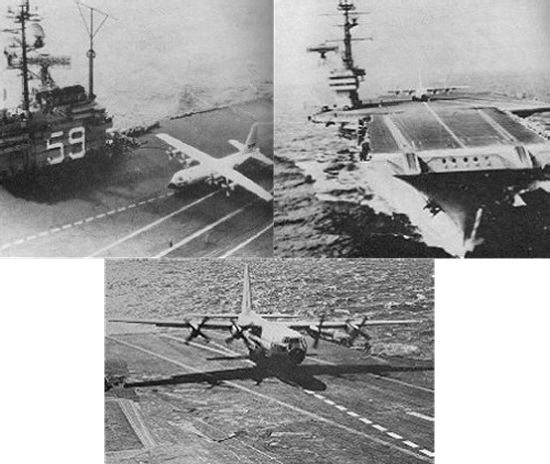
C-130 Aircraft Carrier landing


I would not have thought it possible, be here we see the photo proof that a C-130 can in fact land and take off from an aircraft carrier. This occurred on the USS Forrestal in 1963. It is to this day, the heaviest and largest aircraft landing and takeoff from a carrier. Amazingly, this USMC KC-130F, with a Navy Lieutenant at the helm, landed on the deck without the use of the arrester cables. The C-130 can change the direction of its propeller blades in order to slow the aircraft and land in a much shorter strip. The crew did this just prior to landing to decrease the space needed to stop the aircraft.  Records state that the Hercules made 29 touch and go landings, 21 full stop, unarrested landings and 21 unassisted (no steam catapult) take-offs. Landings and takeoffs were made at several weights from 85,000lbs to 121,00lbs. When at low weight, the Hercules was able to stop in 267 feet, only slightly more than double the wingspan! At the max tested weight, it only required 775 feet for takeoff and 460 feet for landing. This very aircraft was in fact, in service up until 2003 and is now on display at the National Museum of Naval Aviation in Pensacola, Florida. The Navy ultimately decided that the margin for error was too small for operational use and developed the C-2 Greyhound for the COD (Carrier On board Delivery) mission. 


For those that might doubt the veracity of my reporting on this matter, there is a Youtube video of a landing, but embedding was disabled so you will have to go to Youtube all by yourself to see it. 


Oooh look! Color photo of takeoff!

Tuesday, October 4, 2011

F-35B landing on USS Wasp


Here we have video of what was apparently the first F-35B vertical landing on a light carrier. Although Lockheed Martin vice president Steve O’Bryan has said that most F-35B landings will be purely conventional in order to reduce stress on the vertical lift components. The plan for the F-35B is to replace the AV-8B Harrier as the Marine Corps' VTOL aircraft for fighter and attack roles. In 2011, the USMC and USN signed an agreement that the USMC will purchase 340 F-35B and 80 F-35C while the USN will purchase 260 F-35C. The five squadrons of Marine Corps F-35Cs will be assigned to the Navy carriers while the Marine Corps F-35Bs will be used on Amphibious ships and ashore. Nice to see that the program is continuing to make progress.

Monday, January 17, 2011

Medal of Honor Corporal Tony Stein, USMC


*STEIN, TONY

Rank and organization: Corporal, U.S. Marine Corps Reserve.

Born: 30 September 1921, Dayton, Ohio.


Citation: For conspicuous gallantry and intrepidity at the risk of his life above and beyond the call of duty while serving with Company A, 1st Battalion, 28th Marines, 5th Marine Division, in action against enemy Japanese forces on Iwo Jima, in the Volcano Islands, 19 February 1945. The first man of his unit to be on station after hitting the beach in the initial assault, Cpl. Stein, armed with a personally improvised aircraft-type weapon, provided rapid covering fire as the remainder of his platoon attempted to move into position. When his comrades were stalled by a concentrated machinegun and mortar barrage, he gallantly stood upright and exposed himself to the enemy's view, thereby drawing the hostile fire to his own person and enabling him to observe the location of the furiously blazing hostile guns. Determined to neutralize the strategically placed weapons, he boldly charged the enemy pillboxes 1 by 1 and succeeded in killing 20 of the enemy during the furious single-handed assault. Cool and courageous under the merciless hail of exploding shells and bullets which fell on all sides, he continued to deliver the fire of his skillfully improvised weapon at a tremendous rate of speed which rapidly exhausted his ammunition. Undaunted, he removed his helmet and shoes to expedite his movements and ran back to the beach for additional ammunition, making a total of 8 trips under intense fire and carrying or assisting a wounded man back each time. Despite the unrelenting savagery and confusion of battle, he rendered prompt assistance to his platoon whenever the unit was in position, directing the fire of a half-track against a stubborn pillbox until he had effected the ultimate destruction of the Japanese fortification. Later in the day, although his weapon was twice shot from his hands, he personally covered the withdrawal of his platoon to the company position. Stouthearted and indomitable, Cpl. Stein, by his aggressive initiative sound judgment, and unwavering devotion to duty in the face of terrific odds, contributed materially to the fulfillment of his mission, and his outstanding valor throughout the bitter hours of conflict sustains and enhances the highest traditions of the U.S. Naval Service.

Friday, October 15, 2010

Marines love the Misfits


Nothing much to say about this one, it of course reminds me of all the images of soldiers and Marines from Vietnam with various sayings written on their helmets or flak jackets.
If you don't know the reference, it is from a song by the Misfits, a punk band, if you don't know them get a copy of Walk Among Us. It rocks.

Tuesday, June 8, 2010

Medal of Honor - SGT Robert E. O'Malley, USMC


O'MALLEY, ROBERT E.

Rank and organization: Sergeant (then Cpl.), U .S. Marine Corps, Company 1, 3d Battalion, 3d Marine Regiment, 3d Marine Division (Rein).

Place and date: Near An Cu'ong 2, South Vietnam, 18 August 1965.

Entered service at: New York, NY

Born: 3 June 1943, New York, NY

Citation: For conspicuous gallantry and intrepidity in action against the communist (Viet Cong) forces at the risk of his life above and beyond the call of duty. While leading his squad in the assault against a strongly entrenched enemy force, his unit came under intense small-arms fire. With complete disregard for his personal safety, Sgt. O'Malley raced across an open rice paddy to a trench line where the enemy forces were located. Jumping into the trench, he attacked the Viet Cong with his rifle and grenades, and singly killed 8 of the enemy. He then led his squad to the assistance of an adjacent marine unit which was suffering heavy casualties. Continuing to press forward, he reloaded his weapon and fired with telling effect into the enemy emplacement. He personally assisted in the evacuation of several wounded marines, and again regrouping the remnants of his squad, he returned to the point of the heaviest fighting. Ordered to an evacuation point by an officer, Sgt. O'Malley gathered his besieged and badly wounded squad, and boldly led them under fire to a helicopter for withdrawal. Although 3 times wounded in this encounter, and facing imminent death from a fanatic and determined enemy, he steadfastly refused evacuation and continued to cover his squad's boarding of the helicopters while, from an exposed position, he delivered fire against the enemy until his wounded men were evacuated. Only then, with his last mission accomplished, did he permit himself to be removed from the battlefield. By his valor, leadership, and courageous efforts in behalf of his comrades, he served as an inspiration to all who observed him, and reflected the highest credit upon the Marine Corps and the U.S. Naval Service.

Tuesday, February 23, 2010

Medal of Honor- LTC Aquilla James Dyess, USMC Reserve

AQUILLA JAMES DYESS

Rank and organization: Lieutenant Colonel, U.S. Marine Corps Reserve.

Born: 11 January 1909, Augusta, Ga.

Appointed from: Georgia.

Citation: For conspicuous gallantry and intrepidity at the risk of his life above and beyond the call of duty as Commanding Officer of the 1st Battalion, 24th Marines (Rein), 4th Marine Division, in action against enemy Japanese forces during the assault on Namur Island, Kwajalein Atoll, Marshall Islands, 1 and 2 February 1944.

Undaunted by severe fire from automatic Japanese weapons, Lt. Col. Dyess launched a powerful final attack on the second day of the assault, unhesitatingly posting himself between the opposing lines to point out objectives and avenues of approach and personally leading the advancing troops. Alert, and determined to quicken the pace of the offensive against increased enemy fire, he was constantly at the head of advance units, inspiring his men to push forward until the Japanese had been driven back to a small center of resistance and victory assured. While standing on the parapet of an antitank trench directing a group of infantry in a flanking attack against the last enemy position, Lt. Col. Dyess was killed by a burst of enemy machine gun fire. His daring and forceful leadership and his valiant fighting spirit in the face of terrific opposition were in keeping with the highest traditions of the U.S. Naval Service. He gallantly gave his life for his country.


I learned about LTC Dyess when I visited the Augusta, GA Museum of History a few months ago. There is a display set up to honor him and his family donated his Medal of Honor to the museum.

Monday, February 8, 2010

Armored Vehicles: Assault Breacher Vehicle (ABV)

This is a new, experimental vehicle for the USMC. It is known as the Assault Breacher Vehicle (ABV). Hopefully it will get some awesome, mean-ass name soon. Feel free to leave your suggestions in the comments. It is based on a M1 Abrams Tank chassis. Its purpose is to clear the route for other allied vehicles and troops. In many ways, it is the the Marines' answer to the threat that is posed by Improvised Explosive Devices (IEDs) and mines, which have been the greatest cause of casualties in Iraq and Afghanistan. The M1 series of tanks, with its heavily armored underbody, is probably the most mine resistant vehicle in the current US arsenal and the ABV will probably be the best of the series in that respect.


To clear and combat hidden explosives the Assault Breacher is equipped with a variety of systems, such as a full-width mine plow, two linear demolition charges, and a lane-marking system. The crew cabin is covered in reactive armor to provide additional protection against modern RPGs and guided anti-tank missiles. The vehicle mounts a M2HB .50 caliber machine gun in a remote station for defense against infantry and light vehicles and the turret has been replaced with a reinforced steel superstructure. There are also smoke and chaff grenade launchers that cover the front arc of the vehicle. You have to give it some points for looking mean too. I mean look at this thing. It looks like it eats refrigerators.


The Assault Breacher Vehicle (ABV) operates as part of the combined arms task force and is assigned to and employed by Combat Engineers. It is meant to breaching capability to the assault force of the Marine Air Ground Task Force (MAGTF). It is fast and mobile enough to keep up with the tanks, APCs and other vehicles. In addition to IEDs and mines, the ABV will likely be able to destroy many types of static obstacles such as sand berms, barricades, and so forth. I sure as hell wouldn't stand in front of it. The ABV will be able to clear a lane that is wide enough for the assault forces and will be operated by a two-man crew with an option for remote control. The Assault Breacher will allow assault units to move rapidly through mine fields and trapped roads, destroying the enemies' ability to make use of obstacles and IEDs to slow or trap and have an opportunity to mass fires or establish defenses.


The linear demolition charges are known as theM58 Mine Clearing Line Charge (MICLIC).
It is fired via rocket toward an enemy mine field and is filled with explosives. The idea is that the blast and concussion of the charges will set off all the mines, leaving a clear path 8 by 100 meters long through the field. It makes a huge explosion and is reportedly one of the loudest weapons used by anyone. It contains 5 pounds of C4 explosive per linear foot and is 350 feet long. That is 1750 pounds of C4. You could probably destroy a few blocks of houses with that much explosive.

ABV firing a mine clearing charge

Sunday, January 10, 2010

Military Technology- GLARE LA-9/P


This is a new item being tested and evaluated by the USMC. It is called the GLARE LA-9/P. it is apparently classified as a "ocular interruption device". The GLARE is visible and effective up to 2.5 miles. It is classified as a less than lethal weapon, although personally, I wouldn't be surprised if this thing would give you eye-cancer. The LA-9/P is listed as a 250 milliwatt laser and is made by BE Myers. My quite insufficient wikipedia research tells me that it would likely fall into the Class IIIb/3B lasers which can cause immediate severe eye damage upon exposure. These are usually lasers up to 500 mW, such as those in CD and DVD writers. Note that it seems the housing states that the laser is eyesafe at 62.9 meters. According to the manufacturer, there is a safety that automatically deactivates the laser if a target is within the danger zone (the nominal ocular hazard distance or NOHD). So that is nice.

Above it is mounted on a folding stock for a Ruger. That's also nice, because those are about $85.00, and if we let the "military-industrial complex" make one, it would probably cost at least $450.00. I'm all about keeping costs down. It is powered by AA and 123 batteries, which are pretty easy to acquire anywhere, although the 123s can be expensive little bastards.


One possible use for a weapon of this type, is that of a long range warning device. The HBO miniseries Generation Kill showed that the Marines had a difficult time warning civilians and refugees to stop at roadblocks, sometimes with unfortunately fatal results. A device like this is clearly visible for long ranges and could be used to force a car to stop well short of the range where they could injure friendlies. Of course, it also might cause you to drive into a ditch.

As seen below, it could also be used for signaling and hailing, especially for ship to ship or airborne overwatch needs.


GLARE LA-9/P > Model No. 532C-LA-9/P

NSN Number: 5860-01-544-7175
Output Power (Visible): 250 mW
Wavelength: 532 nm (green)
Visible Beam Diverg. (Degrees): .29°
Power Supply: 4 AA & 1 Type 123
Dimensions: 10.25 x 1.75 x 2.25 in
Weight (With Batteries): 20.5 oz
NOHD: 63m (10 s exposure)
Effective Range (Hail & Warning): 300m (Day) - 4 km (Night)
1913 Rail Mount Available: Yes

Sunday, December 20, 2009

Wasp class Amphibious Assault Ship


Above is the USS Wasp, the first of the Wasp-class Amphibious Assault Ships. These ships are designed to land forces on a hostile shore and support them. They are the largest such ships in the world and in many ways, are more powerful than the aircraft carriers of other nations and aircraft carriers from the past. The Wasp-class has the ability to launch surface craft from its rear well deck and can also launch helicopters and AV-8B Harrier II STOL aircraft from its flight deck. Sometimes the LHD will carry as many as 20 Harriers when it is configured as a "Harrier Carrier" with a narrower focus on close air support of ground forces.
The LHD launches LCACs (Landing Craft, Air-Cushioned - hovercraft) and LCUs (Landing Craft Utility) to ferry Marines and supplies to the store. They can also launch the AAVs (Amphibious Assault Vehicles). To further support operations on shore, every Wasp-class warship has a hospital with 600 patient beds and six operating rooms.


USS Wasp embarking a LCAC

The Wasp-class is descended from the earlier Tarawa-class. The main differences are that the Wasp is longer to fit the LCAC and does not have the 5 inch guns of the Tarawa-class. These ships are named after famous battles of the United States Marine Corps or for WWII aircraft carriers. The entire Wasp-class of eight ships was built at the Ingalls Shipbuilding Co. in Pascagoula, Mississippi, the USS Wasp being commissioned on July 30, 1989.

Landing Craft Utility in the well deck of the USS Essex


General characteristics
Class and type: amphibious assault ship
Displacement: Approx. 40,500 tons (41,150 metric tons) full load
Length: 844 ft (257 m)
Beam: 106 ft (32 m)
Propulsion: Two boilers, two geared steam turbines, two shafts, 70,000 shaft-horsepower (52 megawatt);
but two General Electric LM2500 geared gas turbines, two shafts on the USS Makin Island)
Speed: 20 knots (37 km/h)

Complement: 104 officers, 1,004 enlisted
1,894 Marine Detachment

Armament: Two Rolling Airframe Missile launchers
Two Sea Sparrow missile launchers
Three 20 mm Phalanx CIWS systems (LHD 5-7 with two)
Four .50 BMG machine guns
Four 25 mmMk 38 chain guns (LHD 5-7 with three).
Aircraft carried: Actual mix depends upon the mission[1]

Standard Complement

6 AV-8B Harrier II attack aircraft
4 AH-1W SuperCobra attack helicopter
12 CH-46 Sea Knight helicopters
4 CH-53 Sea Stallion helicopters
3 UH-1N Huey helicopters
OR
Assault
42 CH-46 Sea Knight helicopters
OR
Sea Control
20 AV-8B Harrier II attack aircraft
6 SH-60F/HH-60H ASW helicopters

Thursday, October 8, 2009

Medal of Honor- GST Daniel Daly, USMC


Gunnery Sgt. Daniel Daly was born in 1873 in New York. A warrior by nature, Daly enlisted in the U.S. Marine Corps to fight in the Spanish-American War in 1899, but the war was over by the time he finished his basic training. Instead, he was deployed to China in 1900 to put down the Boxer Rebellion. Defending a wall bastion by himself and suffering numerous wounds, Daly inflicted 200 casualties until reinforcements arrived, and received his first Medal of Honor.
For his second Medal of Honor, his citation reads:

"Gunnery Sergeant Daniel Daly, United States Marine Corps, on the night of October 24, 1915, three officers and 35 enlisted men were attacked by 400 Cacos while crossing a river in a deep ravine concealed in bushes about 100 yards from a fort. The Marine detachment fought its way forward to a good position which it maintained during the night, although subjected to a continuous fire from the Cacos.

"At daybreak the Marines in three squads under the command of Captain Upshur, Lieutenant Osterman and Gunnery Sergeant Daly advanced in three different directions, surprising and scattering the enemy in all directions. Had one squad failed, not one man of the party would have lived to tell the tale. Gunnery Sergeant Daly, 15th Company, during the operations was the most consipicuous figure among the enlisted men."


Daly is famous for yelling, in this battle, "Come on, you sons of bitches, do you want to live forever?"

(So no, it wasn't Johnny Rico of the Mobile Infantry for you scifi nerds)

Daly saw his service in the Marine Corps as a vocation and never married. After serving on the front lines for almost two years in WWI, he moved to the Marine Reserve and spent the last 17 years of his life as a bank guard. He turned down numerous offers for officership because he preferred to be an "outstanding sergeant" than just another officer.