Wednesday, January 13, 2010

Citadelle Laferriere


This is the Citadelle Laferriere in Northern Haiti. I thought I would post the pics and a little background on it as Haiti has been in the news lately as a result of a massive 7.0 earthquake centered right below the capital of Port au Prince.


The Citadel was built between 1805 and 1820 by as many as 20,000 workers. It was built at the direction of Henri Christophe, who was one of the most important leaders during the Haitian slave revolt. The Citadel is the largest fortress in the Western Hemisphere and was awarded the status of a UNESCO World Heritage site in 1982. It was built to withstand an attack by the French that never came. The site was chosen well, being several miles inland to protect from naval bombardment and sitting atop a 3,000ft mountain called Bonnet a L'Eveque. From this height it dominates the surrounding terrain and provides a lookout into the valleys that adjoin it. from the network of walkways that make up the roof, the city of Cap-Haiten and the Atlantic are visible, and on a clear day one can see the coast of Cuba, about 90 miles away.

Henri Christophe was a General in the Haitian Army and in 1806, he and Alexandre Petion instigated a coup against the Emperor of Haiti, Jean-Jacques Dessalines. After Dessalines' death, the island was divided in two and Christophe declared himself King in 1811. Henri committed suicide in 1820 following a stroke and was interred in its courtyard to avoid his corpse being mutilated by his enemies.


Stacks of Cannonballs still sit in the Fortress

The Citadel's walls reach a height of 130 feet from the top of the mountain and the complex covers an area 108,000 square feet. The large foundation stones of the fortress were laid directly into the stone of the mountaintop and fastened using a mortar mixture which included quicklime, molasses, and the blood of local cows and goats. (Sounds tasty) The fortress was designed and stocked to be able to house a garrison of 5,000 troops for one year. It included a larges cistern and large warehouses for food and other supplies. The citadel also had bakeries, dungeons and sumptuous (for the time) apartments for the King and his family and retainers. It was armed with more than 365 cannons, of many different sizes and manufactures. Huge stockpiles of cannonballs are still stacked at the base of the walls.

In the event of an invasion, the plan was that the soldiers would burn the crops along the coast and then retreat to the fortress, setting ambushes along the sole mountain path leading to the Citadel. Whether this would have worked is in question as the French at the time had the world's leading artillery and military engineers, including massive mortars that could likely knock out huge chunks of the walls with each shot. By the middle nineteenth century, weapons like the Parrot gun and other large rifled artillery pieces could have very well destroyed the fortress. In effect, not long after it was built and stocked, it was obsolete. Still, it stands as a wonderful example of military architecture of the period.

The appearance of the Citadel assumes different geometric forms based on the one's point of view. It has been said that from the trail leading up to its base it resembles the prow of a ship. It is quite likely that this structure is still standing, as it was pretty far from the center of the quake and it is old enough to have withstood several other earthquakes in its time.

Sunday, January 10, 2010

COIN Aircraft

A-1 Skyraider

COIN is the military acronym for Counter Insurgency. Counter insurgency warfare has been, in a lot of ways, the main type of warfare we have been involved in since the end WWII. Certainly most of the Vietnam War, Iraq War, and the War in Afghanistan are counter insurgency campaigns.

Many of the tasks that I am going to discuss here can and have been accomplished by other aircraft. F-16s and F-18s are very good at hitting ground targets and carry weapons that can utterly destroy most anything. But they often can only stay above the battle for very short period of time, sometimes as little as 30 minutes. A savvy enemy can realize that if they lay low for a little while, the aircraft will have to leave the area to refuel. Aeriel refueling and stacking aircraft to come on station in sequence can help solve this problem. Advanced jets are also difficult or impossible to operate from small, primitive airfields, forcing commanders to fly them to their targets from further away.

Helicopters such as the AH-64 Apache and AH-1 Cobra are very useful in attacking ground targets, but also have limitations. They are in general much easier to shoot down than planes as they fly lower and are very much slower. They also may be unsuitable for certain types of time sensitive air support as they can't respond with the same speed as fixed wing craft.

Some of you might be thinking, man, this guy has completely forgotten about the best close air support plane in the air, the A-10 Thunderbolt II/ Warthog. No, I didn't. And the A-10 is probably the best close air support plane in our inventory (Sorry Harrier, you are cool too). But even the A-10 is not perfectly suited to supporting troops on the ground. The A-10 was mostly intended to destroy hordes of Soviet tanks on a open, plains-type environment.
The A-10 is in the process of being upgraded to allow it to use more precision weapons and that will increase its usefulness.


For an aircraft to be successful and useful in a counter insurgency situation, it must have a balance of several attributes.

1. Endurance: The aircraft must be able to loiter over the battlefield for extended periods of time to provide support for troops on the ground.

2. Slow speed maneuverability: To accurately hit small and camouflaged ground targets, the aircraft must be able to fly low and slow to be able to see. Higher speed aircraft like the F-16 have difficulty moving slow enough to spot targets like small bunkers, and even if they see them, they usually will have to come around for another pass, because they have flown a few thousand feet by the time they can recognize and confirm the target.

3. Survivability: Since the aircraft has to hang around a long time, flying low and slow, it is certainly going to receive ground fire from small arms, AA guns, rockets, and surface to air missiles. The aircraft has be designed to meet these threats as well as possible. Part of this is making the aircraft as tough as possible with extra armor for the pilots and redundant systems. Another is making sure the aircraft has systems like chaff and flares to increase its resistance to advance anti-air weapons.

So where does this leave us? What is the solution? Well, the simplest thing may be to buy and field more helicopter gunships, A-10s and even armed UAVs.
Another approach is to look backward. The US military has flown many excellent propeller driven aircraft in the past that would, with some modification, make excellent COIN aircraft.
Why propellers? Well, for starters, they are easier to operate in austere environments, they also are much harder to target with Infrared guided missiles as they do not generate anywhere near the heat of a jet engine.


This one is an outside possibility, but has a solid a combat record as can be wished.
This is the A-1 Skyraider, a plane designed for WWII that was so good, it was used all the way into Vietnam, well into the jet age. The Skyraider was very tough and had excellent low speed handling due to a large, low, straight wing. Notice the large speed brake beneath the fuselage. This allows the pilot to very quickly drop his airspeed, like letting the air out of a sail. That means they can approach a target quickly, slow down, bomb the crap out of it, and then throttle up and get out of there. While the A-1 is a wonderful plane and could be useful, it is extremely doubtful that the Pentagon would bring back a plane of this age.


Next up, the OV-1 Mohawk, a joint Marine/Army project from the Vietnam era. This was a light twin prop aircraft, designed for observation and reconnaissance as well as air strikes. It satisfies the requirements of a rugged plane, able to operate from small, unimproved fields. It also has a good loiter time and can be easily modified to accomplish different missions. The Mohawk was fitted with pods to drop supplies to troops from its under wing hardpoints. This is a wonderful addition, because sometimes a couple of hundred rounds and a few gallons of water can make the difference between life and death for besieged ground pounders. It has a side by side cockpit arrangement that increases the situational awareness of the pilots. The Mohawk was in inventory until the 1990's and was replaced by aircraft such as the DH-7 and the E-8 J-STARS. The OV-1 was primarily an aircraft dedicated to seeking out the enemy, rather than destroying it, and inter service squabbles between the Army and the Air Force doomed the further use of armed fixed wing planes for Army use. That is a shame, because there have been some in the Air Force that have been less than enthusiastic about flying the types of missions the Army needs them to, but they don't want the Army flying them either.


One of the best candidates is the OV-10 Bronco, another Vietnam era observation plane. It can loiter for up to three hours and was specifically designed for CAS and COIN. This aircraft was developed during the infancy of combat helicopters and was intended to be used for Forward Air Control (FAC). The Bronco was designed to be extremely versatile. It could take off from roads and fields, met the short takeoff and landing criteria of 800 feet, it could be launched from a aircraft carrier. The original specifications stated that it should be convertible to an amphibian, but I don't know it that ever panned out. It could be armed with 7.62mm machineguns, a 20mm cannon, Sidewinder missiles and carry 500 lb. bombs on its wings. With the second seat removed, it can carry 3,200 pounds of cargo, five paratroopers or two litter patients and an attendant. Normal operating fueled weight, with two crew was 9,910 lb. Maximum takeoff weight was 14,446 pounds.

One interesting feature is that the Bronco was originally developed to strafe weapons with self-loading recoilless rifles, which could deliver aimed explosive shells with less recoil than cannons, and a lower per-round weight than rockets. The airframe would thereby avoid the back blast. The Bronco performed observation, forward air control, helicopter escort, armed reconnaissance, gunfire spotting, utility light air transport and limited ground attack. The Bronco has also performed aerial radiological reconnaissance, tactical air observation, artillery and naval gunfire spotting and airborne control of tactical air support operations, and front line, low-level aerial photography.

A newer version of the Bronco, known as the OV-10X is under development by Boeing and it would feature the ability to use precision weapons, advanced sensors and avionics, but still retain the robust and simple construction of the original.


This is the Ayres Vigilante, a militarized version of the Thrush, which is the most popular agricultural plane ever. The government has several modified aircraft of this type that were used to destroy Colombian coco crops. These aircraft are a special anti-narcotics crop-spraying version of the Turbo-Thrush and were bought for for the US State Department. This version, known as the Narcotics Eradication Delivery System (NEDS) featured an armoured cockpit and engine to protect against hostile ground fire. Attempts were made to find military buyers in the mid eighties, but the Air Force was not interested.


My favorite of the bunch, this Piper PA-48 Enforcer. It is a more modern take on the greatest fighter of WWII, the P-51 Mustang. It has been fitted with wing mounted fuel tanks and what I believe is a spar for aerial refueling. Notice the 10 (!) under wing hardpoints. This would allow the Enforcer to carry a large and varied load of ordinance. It could easily be fitted with laser guided 70mm folding fin rockets, 250 and 500 pound bombs, etc. It also was tested with 6 .50 caliber machine guns, although a 20mm cannon or two would probably be more useful. Like the rest of the aircraft here, it is a robust plane, capable of operating almost anywhere.Unfortunately, the Air Force never showed much interest in the Enforcer, despite years of development and the best pedigree a prop plane could ask for. Only four were ever made.

Military Technology- GLARE LA-9/P


This is a new item being tested and evaluated by the USMC. It is called the GLARE LA-9/P. it is apparently classified as a "ocular interruption device". The GLARE is visible and effective up to 2.5 miles. It is classified as a less than lethal weapon, although personally, I wouldn't be surprised if this thing would give you eye-cancer. The LA-9/P is listed as a 250 milliwatt laser and is made by BE Myers. My quite insufficient wikipedia research tells me that it would likely fall into the Class IIIb/3B lasers which can cause immediate severe eye damage upon exposure. These are usually lasers up to 500 mW, such as those in CD and DVD writers. Note that it seems the housing states that the laser is eyesafe at 62.9 meters. According to the manufacturer, there is a safety that automatically deactivates the laser if a target is within the danger zone (the nominal ocular hazard distance or NOHD). So that is nice.

Above it is mounted on a folding stock for a Ruger. That's also nice, because those are about $85.00, and if we let the "military-industrial complex" make one, it would probably cost at least $450.00. I'm all about keeping costs down. It is powered by AA and 123 batteries, which are pretty easy to acquire anywhere, although the 123s can be expensive little bastards.


One possible use for a weapon of this type, is that of a long range warning device. The HBO miniseries Generation Kill showed that the Marines had a difficult time warning civilians and refugees to stop at roadblocks, sometimes with unfortunately fatal results. A device like this is clearly visible for long ranges and could be used to force a car to stop well short of the range where they could injure friendlies. Of course, it also might cause you to drive into a ditch.

As seen below, it could also be used for signaling and hailing, especially for ship to ship or airborne overwatch needs.


GLARE LA-9/P > Model No. 532C-LA-9/P

NSN Number: 5860-01-544-7175
Output Power (Visible): 250 mW
Wavelength: 532 nm (green)
Visible Beam Diverg. (Degrees): .29°
Power Supply: 4 AA & 1 Type 123
Dimensions: 10.25 x 1.75 x 2.25 in
Weight (With Batteries): 20.5 oz
NOHD: 63m (10 s exposure)
Effective Range (Hail & Warning): 300m (Day) - 4 km (Night)
1913 Rail Mount Available: Yes

Wednesday, January 6, 2010

Hidden and Disguised Firearms


OK, before we get started. Most of these are most likely illegal. Very illegal. Like "10 to 20 for possession" illegal. I wish to highly discourage you from attempting to acquire or manufacture firearms like these. Unless you are an asshole, in which case, have fun in the State penitentiary. Most of these weapons would also, in practice, not be very useful. Some of them might very well be dangerous to the person firing them.


This is a folding knife with a essentially barrelless single shot .22 attached. It is fired by pulling the tab on the back of the grip and letting it go. With no barrel to speak of, no sights, and the fact that it is a .22, why not just stab them?
Verdict: Useless.


This is the H&K Mp5K in a specially built briefcase. I don't know for sure, but I doubt that H&K built the case. They are too smart for that. It does have mechanism for firing the weapon while it is inside. However, holding it like a regular briefcase and firing without sights, combined with the high rate of fire of the MP5K, I imagine you would be out of ammo before you figured out that you hadn't hit anything. Here is a video of it in action.

In some other video, you can see that by holding it horizontal and using tracers, you can kind of walk it onto a target, but still I have to say:
Verdict: Awesome, but not all that effective.

Here we have another .22 single shot, hidden inside a mini Maglight this time. The construction of this one seems to be of a higher quality than some of the weapons we are looking at today, and unlike some of its peers, this one would actually pass as something other than a cheaply made zipgun. I believe this gun was made by ARES Defense.
Verdict: Might make a decent gun, but a waste of a good flashlight.

This is a 5 shot, 5 barrel cell phone gun from Europe. Thank these assholes for having to have your phone scanned at the airport. Chambered in .22 to avoid the whole thing splitting in half, the news articles from a few years ago when these were first found said that they were fired by pressing 3 buttons at once. You, know, like when you put it in your pocket. The cell phone gun may be the most dangerous on the list so far, as it has decent power (5 .22 bullets at 1200 fps all at once could be quite deadly) and it actually looks like a real phone, lights up and everything, and since everyone has a phone, you could get close to someone without any undue suspicion.
Verdict: Usable, but for assholes.

This is a pen gun seized from a Mexican drug lord recently. It is chambered in .22 and pictured with it we see several .22 Short bullets and 1 subsonic .22 LR. One problem with this is that it doesn't really look like a pen very much. Certainly not enough to fool someone. So why don't you just carry a real gun? There are a whole lot of different pen guns, and I would probably not fire any of them unless someone did it before me. They are mostly made by idiots and rely on less than reliable systems. It looks like this one is fired by pulling back the knob and letting it go. You know, like what would happen when you put the thing in your pocket.
Verdict: Bad Idea and Useless.

This is Sedgley glove gun from WWII. It was developed for the OSS, which was one of the forerunners of the CIA. It was chambered in .38 and fired by pressing the plunger into someone. This thing looks like something made by my miscreant friends and I when we were 12. It is also the only gun I've ever heard of that needs to be in contact with the target to work. If you are that close, hitting them with a rock would probably work just as good.
Verdict: Dangerous. (For the guy wearing it)


Here we have a 12 gauge Mossberg that has been inserted into a Supersoaker water gun. Pretty smart, although I wouldn't be surprised if the watergun flew into pieces when you fire the shotgun. A nice touch was the orange "non-lethal" pistol grip on the shotgun.
Verdict: Well, If it was a that good an idea, it wouldn't be in a police evidence room.


This is one of the many versions of the folding submachine gun. Some have been made by Ares and there are pics of a prototype from Magpul. You might think this one is junk like most of the rest of them, but it is an actual production weapon, made in a factory, not a garage or basement. Weapons like this have been famously used by the US Secret Service and that mean little kid in Robocop 2. (a classic)
Verdict: Neat and Useful


If memory serves, this credit card gun was made in Minnesota by AFT, Inc., and as you can see, fires small .177 BBs. Which are way too small to be very effective. It functions as a muzzle loader, requiring the user to measure out powder and tamp it in with a paper patch and then the BBs. It also is way to thick to actually be mistaken for a credit card, unless the person in question is just as thick.
Verdict: Amusing, but Useless.


Preparedness

A Good Idea: Crist PDW


Here was a good idea that was for whatever reason was not adopted.
The problem is this: Pistols are hard to shoot very well. Especially if you don't practice much or are under stress. So a pistol as a personal defense weapon is not really the best idea. They have very little accuracy beyond 50 feet or so, almost no ability to breach body armor, and have relatively small magazines, as a rule. The only thing going for them is they are small and light. Many Soldiers, Sailors, Airmen, and Marines such as pilots, vehicle crews, mechanics, medics, artillerymen and so forth need a weapon, but are not really expected to use it in less there is a real emergency. The M16 series, relatively long and heavy and maintenance intensive, is not the best choice. What is needed is a weapon designed (or modified) for the PDW role, it needs to be light and small enough to not be in the way during the soldiers' main tasks, yet accurate, reliable and powerful enough to neutralize the enemy. It would also be nice to be in a caliber already in use by the force in question, so we don't make the poor logistics people have a fit.

FN P90, 5.7x28mm

In recent years we have seen FN and H&K release select fire Personal Defense Weapons (PDW) designed to replace the common 9mm sidearms issued to many support troops
There are some who think that the new PDW cartridges (5.7x28mm and 4.6x30mm) are not powerful enough. The argument is that the terminal effectiveness is compromised by the fact that these light bullets do not "dump" enough energy into the target. Weather that is true, I don't know. But it is true to say that both cartridges were designed to be high velocity, armor piercing bullets. In the past many have said that small diameter, high velocity bullets are less effective than a larger, heavier bullet.

H&K Mp7, 4.6x30mm

Enter the Crist PDW concept. It replaces the barrel and slide of the Beretta 92 series, which is the official sidearm of the US Armed Forces. It gives the user a longer barrel which gives higher velocity and increased accuracy. Along with a collapsible butt stock and space to use a true two handed grip, the effective accuracy of the Crist PDW would be much higher than the standard M9. And that doesn't even bring into the equation the provision to mount a red dot sight on the rail. On my recent vacation, I fired a 9mm Beretta Storm carbine and its accuracy was enough to hit small targets at 100 yards, more than enough for the PDW role. Another strength of the Crist system is that it would not necessitate a change of ammunition. Anyone who follows US military technology would be forced to assume that the Pentagon plans on using the 5.56mm and 9mm for the next 300 years or so. The Crist is also small enough to be worn on a leg holster. The big upside for the Department of Defense is that they can modify weapons already in stock, use the same ammo and magazines, and still get a better weapon that is needed.


This is another prospective PDW, the VBR-B. It is from Belgium and was designed by Rik Van Bruaene. It is a select-fire weapon with a collapsible stock and uses common and reliable Glock magazines. It is available in 9mm NATO and a 7.92x24mm VBR cartridge. The 7.92 VBR was designed to function as a armor-piercing round that has superior terminal effectiveness to the 5.7 and 4.6. There are two bullets lengths, one designed for 9mm platforms and the other for the .45ACP. The standard FMJ cartridge is a shortened .30 Carbine case and uses .32 ACP bullets. Seems pretty neat to me. It is still in prototype at this time, but I think it has promise.

Sunday, December 20, 2009

Wasp class Amphibious Assault Ship


Above is the USS Wasp, the first of the Wasp-class Amphibious Assault Ships. These ships are designed to land forces on a hostile shore and support them. They are the largest such ships in the world and in many ways, are more powerful than the aircraft carriers of other nations and aircraft carriers from the past. The Wasp-class has the ability to launch surface craft from its rear well deck and can also launch helicopters and AV-8B Harrier II STOL aircraft from its flight deck. Sometimes the LHD will carry as many as 20 Harriers when it is configured as a "Harrier Carrier" with a narrower focus on close air support of ground forces.
The LHD launches LCACs (Landing Craft, Air-Cushioned - hovercraft) and LCUs (Landing Craft Utility) to ferry Marines and supplies to the store. They can also launch the AAVs (Amphibious Assault Vehicles). To further support operations on shore, every Wasp-class warship has a hospital with 600 patient beds and six operating rooms.


USS Wasp embarking a LCAC

The Wasp-class is descended from the earlier Tarawa-class. The main differences are that the Wasp is longer to fit the LCAC and does not have the 5 inch guns of the Tarawa-class. These ships are named after famous battles of the United States Marine Corps or for WWII aircraft carriers. The entire Wasp-class of eight ships was built at the Ingalls Shipbuilding Co. in Pascagoula, Mississippi, the USS Wasp being commissioned on July 30, 1989.

Landing Craft Utility in the well deck of the USS Essex


General characteristics
Class and type: amphibious assault ship
Displacement: Approx. 40,500 tons (41,150 metric tons) full load
Length: 844 ft (257 m)
Beam: 106 ft (32 m)
Propulsion: Two boilers, two geared steam turbines, two shafts, 70,000 shaft-horsepower (52 megawatt);
but two General Electric LM2500 geared gas turbines, two shafts on the USS Makin Island)
Speed: 20 knots (37 km/h)

Complement: 104 officers, 1,004 enlisted
1,894 Marine Detachment

Armament: Two Rolling Airframe Missile launchers
Two Sea Sparrow missile launchers
Three 20 mm Phalanx CIWS systems (LHD 5-7 with two)
Four .50 BMG machine guns
Four 25 mmMk 38 chain guns (LHD 5-7 with three).
Aircraft carried: Actual mix depends upon the mission[1]

Standard Complement

6 AV-8B Harrier II attack aircraft
4 AH-1W SuperCobra attack helicopter
12 CH-46 Sea Knight helicopters
4 CH-53 Sea Stallion helicopters
3 UH-1N Huey helicopters
OR
Assault
42 CH-46 Sea Knight helicopters
OR
Sea Control
20 AV-8B Harrier II attack aircraft
6 SH-60F/HH-60H ASW helicopters

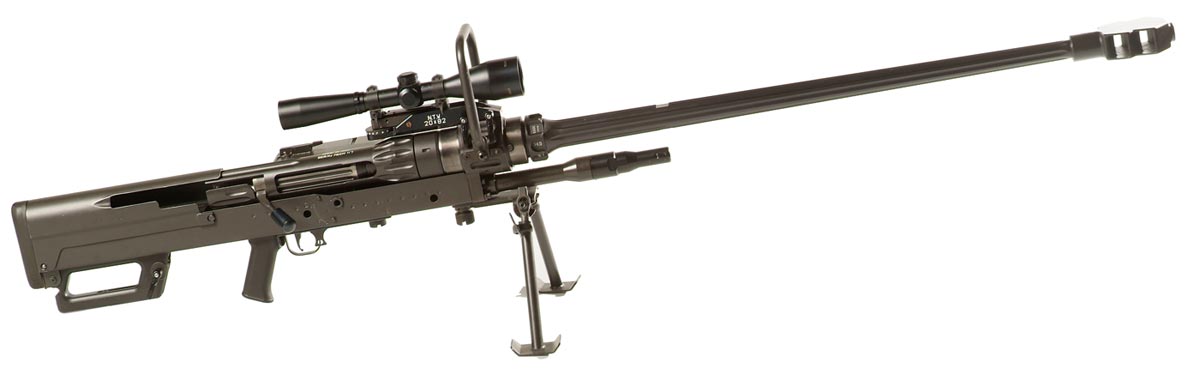
Denel NTW-20 20mm Rifle


Here we have the Denel NTW -20 from South Africa. This is an anti-material weapon mostly designed to destroy important military equipment like radars, aircraft, supply points, and vehicles. This rifle can be configured to fire the Semi-Armour Piercing High Explosive Incendiary (SAPHEI) 20×82mm rounds or the 14.5×114 mm Armour Piercing Incendiary (API). While the 20mm could be used as a "sniper rifle" against enemy personnel, it isn't really made for that. The 14.5mm is much better, with less recoil, increased range and decreased noise, but there are much more effective systems to use. The idea is that a small team of soldiers could cause much havoc behind enemy lines by destroying the equipment needed to fight a war.

Output

One problem with this idea is that firing a gigantic gun like this is sure to draw some attention, primarily of the negative variety. While it has a range of at least 1500 meters, so do most mortars, which is what I would be firing in the direction of the massive report of this monster. So while it is a great weapon, the long term survivability of a team shooting it could be called into question. The weapon itself is absolutely huge, almost 6 and a half feet long and weighing 57 pounds without ammunition. It does break down into two backpacks, but in the real world those soldiers would also be carrying personal weapons, comm gear, armor, water, and food. So mobility is a bit of a problem.


Here is a video from Denel, it shows some of the amazing power this weapon can bring to bear. I don't know who came up with that lame, annoying music though.

Home Security System

HOW TO INSTALL AN INEXPENSIVE HOME SECURITY SYSTEM


1. Go to a secondhand store and buy a pair of men's used size 14-16 work boots.

2. Place them on your front porch, along with a copy of Guns & Ammo Magazine.

3. Put a few giant dog dishes next to the boots and magazines.

4. Leave note on your door that reads:

Bubba,

Bigun, Duke & I went for more ammo and beer. Be back in an hour. Don't mess with the pit bulls cause they attacked the mailman this morning and messed him up bad. I don't think Killer took part, but it was hard to tell from all the blood. Anyway, I locked all four of em in the house. Better wait outside.

Cooter


I found this on the blog, http://womenofcaliber.wordpress.com, by Kellene Bishop all credit to her.

I thought it was pretty hilarious.


Why you should buy a decent gun


This a Lorcin .380 ACP. Notice that the slide has completely split in half. The pistol was reportedly under 200 rounds. Now it is true that any pistol can have catastrophic malfunction, and I've seen plenty of pictures of Glocks and Springfield XDs that have gone ka-boom. But when you think that a gun is a machine designed to harness a small explosion.
And do it a lot. So it really is best to buy a gun you feel that you can trust your life to. It is a lot better to save up another 150 to 250 and buy a mid level used gun like a Ruger, Glock, or even though I don't care for them, a Smith & Wesson.

Wednesday, December 16, 2009

Military Technology- Simon Breaching Munition


One problem faced by soldiers in urban combat is doors. They are everywhere, and you have to get through them. Most are locked and many are heavy enough to stand up to repeated kicks and hammer blows. And that doesn't even touch on the fact that they may be booby trapped.

Enter the Simon from from Rafael in Israel. It is a rifle grenade designed to blow doors clean off their hinges. It has a range of 30 meters and weighs a pound and a half and is about 2.5 feet long. Unlike many other rifle grenades, the Simon can be fired with a regular bullet. Most rifle grenades from years past had to be fired with a special blank cartridge. This meant the user had to keep loose blanks or an extra magazine loaded with blanks. Then, when the grenade was needed he would have to clear the chamber and load the blank, mount the grenade and fire. It would be easy under stress to forget to clear the live round from the chamber. And you do not want that to happen. It could ruin the rifle, the grenade, your day, and maybe your face.


The Simon has a standoff rod that, when fired at the door, causes the impact fuse to detonate. The blast wave of the Simon is large and powerful enough to knock the door inside the room and unlike some other breaching methods, it is not necessary to aim for hinges or locks. The Simon is also in service with the US Army as the M100 Rifle Grenade Entry Munition and was awarded as one of the top 10 best inventions of 2005.

Bet your life

Camoflaged Weapons

Well the poll time has ended and I left it up for more than a month without realizing that I misspelled "modern". Oh well. I don't get paid for this, you know.

64% think that camouflaging a weapon should be the personal choice of its user and 11% think that firearms shouldn't be camouflaged at all. The other 23% are with me and think that modern small arms should all wear some camo. My reasoning is that if you are going to wear camouflage it is silly to have your weapon stick out. Don't believe that? Check these out.

Look at how much more the weapon stands out from the background.
Another thing to consider is that many elite units like the Army Special Forces, SEAL teams and SAS often do camouflage their weapons. And if they do it, everyone should right? ; ) Also, modern "paints" like Duracoat are very good at protecting a weapon from scratches and the elements. Surface rust can begin to form in a day or two on unprotected surfaces. God knows what happens when soldiers get salt water on a gun. I shudder to think.
Nightvision can also make blued and parkerized weapons shine like they are glowing.
Proof you say?
The weapon on the the top is painted, I believe with bowflage, and the lower is a plain AR-15. Notice that the parkered aluminum is very visible. Modern weapons have significant amounts of plastic, and it does not take any more money or time to make them in colors that blend well like olive drab and coyote brown. For those of us who are not paid to be shot at, this is not as vital an issue to be sure. And some people just don't like the aesthetics of camouflaged guns. To each his own. And I've seen some pretty awful paint jobs. But I dare you to look at these and say that they look bad or wouldn't be an improvement over the old standard.

Or you could go this route.